

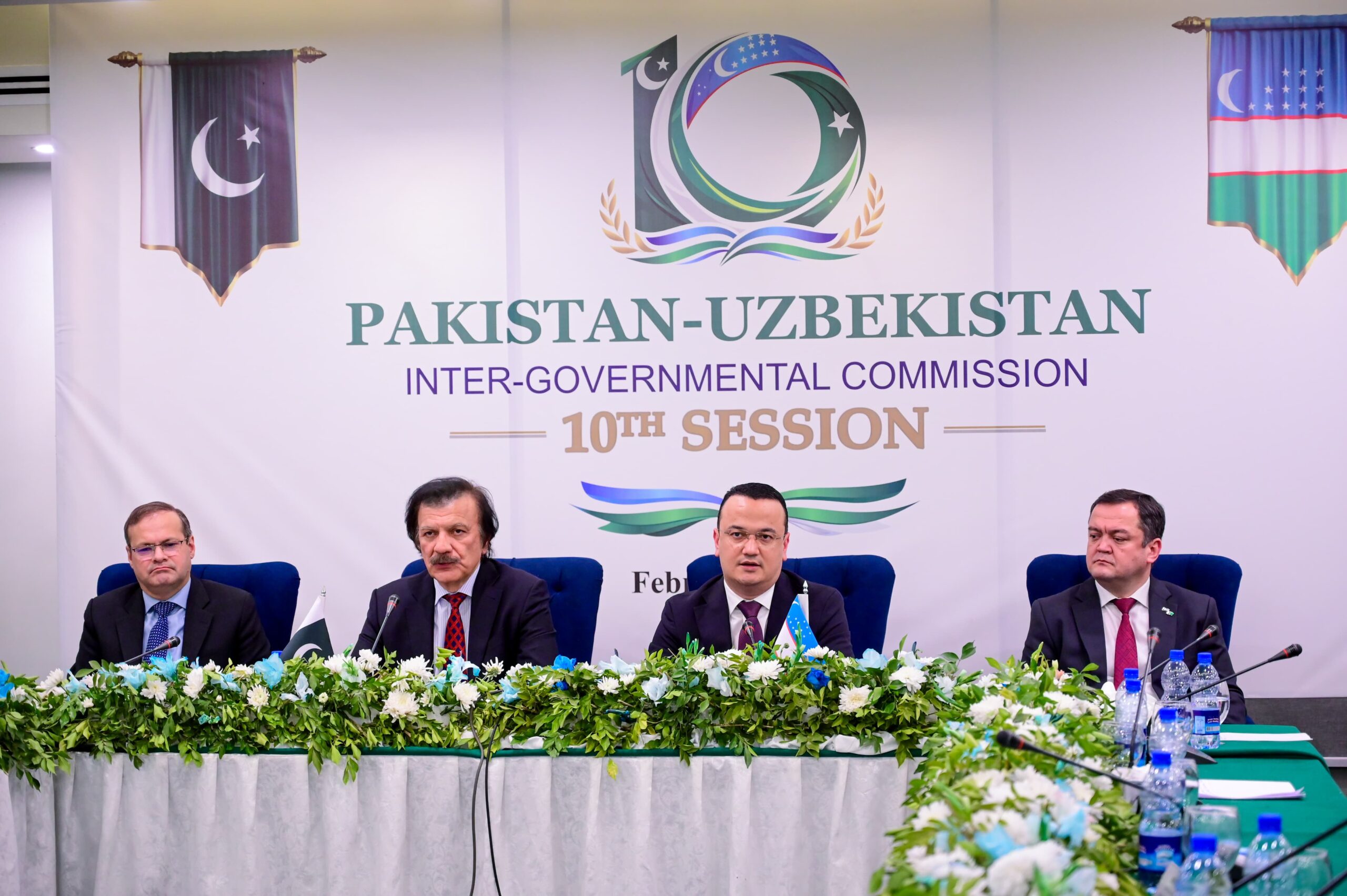
Islamabad, The 10th Session of the Pakistan–Uzbekistan Intergovernmental Commission (IGC) on Trade, Economic, and Scientific-Technical Cooperation was held in Islamabad on 2nd February 2026 under the co-chairmanship of H.E Mr. Haroon Akhtar Khan, Special Assistant to the Prime Minister for Industries and Production, and H.E. Mr. Laziz Kudratov, Minister of Investment, Industry and Trade of the Republic of Uzbekistan. The engagement enabled a comprehensive review of bilateral relations and established a forward-looking roadmap to strengthen joint efforts in major economic and social sectors.
Both sides expressed satisfaction over the steady progress achieved since the previous IGC session in 2025 and reaffirmed their resolve to expand bilateral trade, investment, and economic engagement. The Parties underscored the importance of the Preferential Trade Agreement, welcomed progress under Phase II concessions, and agreed to expedite institutional mechanisms to achieve the agreed target of USD 2 billion in bilateral trade. Emphasis was placed on trade facilitation, improved logistics, customs digitalization, transit trade cooperation, development of regional trade corridors, and enhanced business-to-business engagement, supported by improved visa facilitation for business communities.
Both sides further agreed to establish the inaugural Joint Working Group on labor relations, tasked with addressing labor mobility, skills development, workplace safety, and practical considerations linked to employment visas. In transport and communications sector, the Commission welcomed interest in launching direct air services, reviewed progress on regional railway and connectivity projects, and agreed to advance alternative transport corridors to improve regional trade and transit connectivity.
Cooperation in agriculture and food security featured prominently, with both sides welcoming progress on phytosanitary protocols facilitating the export of fruits from Uzbekistan to Pakistan. The Parties agreed to expand collaboration through additional protocols, joint working groups, and technical cooperation in plant protection, livestock development, and agricultural research, with a shared focus on food security and sustainable agricultural growth.
In higher education, science, and technology, the Commission welcomed progress on academic and research partnerships between leading institutions of both the countries. Both sides agreed to promote joint research, faculty and student exchanges, vocational and technical training, innovation, and capacity building, supported by newly signed agreements in scientific, technical, and innovation fields. These initiatives aim to strengthen long-term knowledge cooperation and human capital development.
Environmental and climate cooperation was recognized as a shared priority, with both sides agreeing to collaborate on climate resilience, protection of glacial ecosystems, sustainable water management, environmental governance, gender-inclusive climate action, and community-based adaptation approaches. In the pharmaceutical sector, the Parties agreed to strengthen regulatory cooperation, promote joint ventures and investment, facilitate exchanges of pharmaceutical manufacturers, and enhance capacity building to ensure quality and safety of medical products.
The Commission further advanced cooperation in energy and minerals, information technology, telecommunications, small and medium enterprises, industry, banking, and finance. Agreements were reached to strengthen joint working groups, promote digitalization and innovation, support SME competitiveness, expand industrial partnerships, enhance banking cooperation, and build institutional capacity.
In their remarks, both Mr. Haroon Akhtar and Mr. Laziz Kudratov reaffirmed the strong bilateral relationship between Pakistan and Uzbekistan and emphasized the importance of translating political goodwill into concrete economic outcomes. They expressed confidence that the decisions taken during the IGC session would deepen institutional linkages, encourage private sector participation, and contribute to sustainable economic growth in both countries.
The Government of Pakistan expressed satisfaction with the outcomes of the 10th IGC session, noting that the agreed decisions reflect a shared commitment to strengthening bilateral cooperation across all priority sectors. Both sides agreed to hold the 11th Session of the Intergovernmental Commission in Tashkent, on dates to be mutually agreed through diplomatic channels.
