


By Qamar Bashir
The fragile pause that briefly held back the flames of a widening Middle East war is now collapsing under the weight of mistrust, unilateral action, and ideological confrontation. What began as a geopolitical conflict between the United States and Iran has rapidly evolved into something far more dangerous—a multidimensional crisis blending military escalation, economic coercion, and increasingly, religious polarization.
At the heart of this renewed escalation lies a bold and controversial decision by Donald Trump: the imposition of a naval blockade targeting Iran’s maritime access through the Strait of Hormuz. This narrow corridor, through which nearly 20% of the world’s oil supply flows, is not merely a regional passage—it is the lifeline of the global energy system. Any disruption here reverberates instantly across economies, markets, and political alliances.
Yet, beyond its economic implications, the blockade raises profound legal and moral questions. Under established principles of international maritime law, a blockade is considered an act of war, typically justified only within a declared armed conflict and subject to strict conditions. The United States, however, is not a coastal state in the Persian Gulf. It lies thousands of miles away, raising immediate concerns about jurisdiction and legality. Experts have already questioned whether such a move violates the United Nations Convention on the Law of the Sea (UNCLOS), which guarantees freedom of navigation in international waters.
From Iran’s perspective, the situation appears even more provocative. As a coastal state bordering the Strait, Tehran argues that it holds legitimate security interests in regulating nearby waters, particularly when facing direct military threats.
Iranian officials maintain that any attempt by external powers to control or blockade the Strait constitutes an infringement on their sovereignty and a violation of international norms. This legal ambiguity is precisely what makes the current situation so volatile—each side claims legitimacy, while the risk of confrontation escalates.
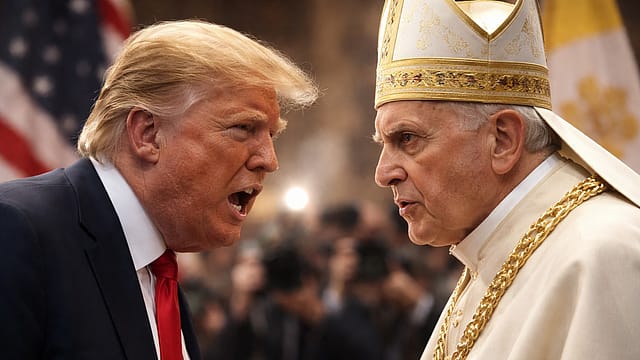
Compounding this already tense environment is a dramatic shift in the narrative—from geopolitical rivalry to ideological confrontation. In an unexpected and deeply symbolic clash, Pope Francis has openly challenged the moral justification of the war. Representing over 2.4 billion Christians worldwide, the Pope has reiterated a long-standing doctrine: that war, especially one targeting civilians, is fundamentally incompatible with the teachings of the Gospel. His call for peace, diplomacy, and humanitarian restraint stands in stark contrast to the rhetoric emerging from Washington.
President Trump, however, has framed the conflict in existential terms, asserting that military action is necessary to prevent Iran from acquiring nuclear weapons—a claim that continues to dominate U.S. strategic thinking. In his public statements, he has gone further, suggesting divine endorsement of his actions, thereby transforming a policy dispute into a theological confrontation. The result is a dangerous convergence of faith and force, where opposing worldviews are no longer confined to policy debates but are amplified through religious narratives.
This escalation is further complicated by shifting alliances and growing dissent within the Western bloc itself. The United Kingdom, under Keir Starmer, has notably distanced itself from the U.S. blockade. While London supports freedom of navigation, it has refused to participate in direct military enforcement, instead advocating for a diplomatic resolution. This divergence signals a broader fracture within NATO, as European nations increasingly question the strategic direction and unilateralism of American policy.
France and other European actors have similarly called for restraint, emphasizing negotiation over confrontation. The proposed international summit on Hormuz reflects this growing consensus: that the crisis cannot be resolved through military means alone. Yet, these diplomatic efforts face an uphill battle against the momentum of escalation.
Meanwhile, the humanitarian toll continues to mount. In the broader regional conflict, particularly involving Benjamin Netanyahu, thousands of civilians have reportedly been killed, and over a million displaced. The International Criminal Court has intensified scrutiny, with arrest warrants and investigations pointing to alleged war crimes, including targeting civilians and imposing collective punishment. These developments further complicate the moral standing of the conflict and amplify global outrage.
Economically, the stakes could not be higher. Any sustained disruption in the Strait of Hormuz threatens to send oil prices soaring, destabilizing global markets and pushing vulnerable economies into crisis. Countries heavily dependent on energy imports—particularly in Asia—face immediate risks. China, one of the largest buyers of Iranian oil, stands at the center of this economic equation. Ironically, earlier U.S. decisions to ease certain sanctions had enabled Iran to sustain its oil exports, indirectly strengthening its economic resilience. The sudden reversal of policy, now aimed at choking these flows, underscores the unpredictability that has come to define the current strategy.
Critics within the United States itself are raising alarms. Questions about strategic clarity, long-term objectives, and the coherence of policy decisions are increasingly being voiced across political lines. Some lawmakers have even suggested reviewing the president’s decision-making processes, citing inconsistencies and abrupt shifts that have contributed to the current crisis.
Yet, perhaps the most dangerous dimension of this unfolding scenario is the risk of direct confrontation at sea. A naval blockade is not a passive measure—it requires enforcement, interception, and, potentially, the use of force. Iranian fast boats, drones, and missile systems are well-positioned to challenge any such attempt. A single miscalculation—a warning shot, a misidentified vessel, or an accidental collision—could ignite a full-scale conflict.
And this is precisely the paradox at the core of the crisis. The blockade, intended as a tool of pressure, may instead become the trigger for escalation. The very act of attempting to control the Strait could provoke the response it seeks to prevent.
Reading between the lines, however, a different narrative begins to emerge. Despite the rhetoric, there are clear indications that major powers, including segments within the United States, are increasingly inclined toward a diplomatic resolution. The reluctance of key allies to engage militarily, the push for international summits, and the growing domestic criticism all point toward an underlying recognition: that war is neither sustainable nor desirable.
The path forward, therefore, lies not in dominance but in dialogue. Recognizing Iran as a legitimate regional actor, rather than an adversary to be subdued, could open the door to meaningful negotiations. A balanced approach—one that addresses security concerns while respecting sovereignty—offers the only viable route to de-escalation.
In the end, the Strait of Hormuz is more than a waterway; it is a symbol of interconnectedness in an increasingly fragmented world. Attempting to control it through force risks not only economic disruption but also a broader unraveling of international order. The challenge before global leadership is not merely to secure passage through these waters, but to navigate the far more complex currents of power, principle, and peace.
The choice is stark: continue down the path of confrontation, where law is contested and faith is weaponized—or step back, recalibrate, and pursue a future where diplomacy prevails over destruction.
