

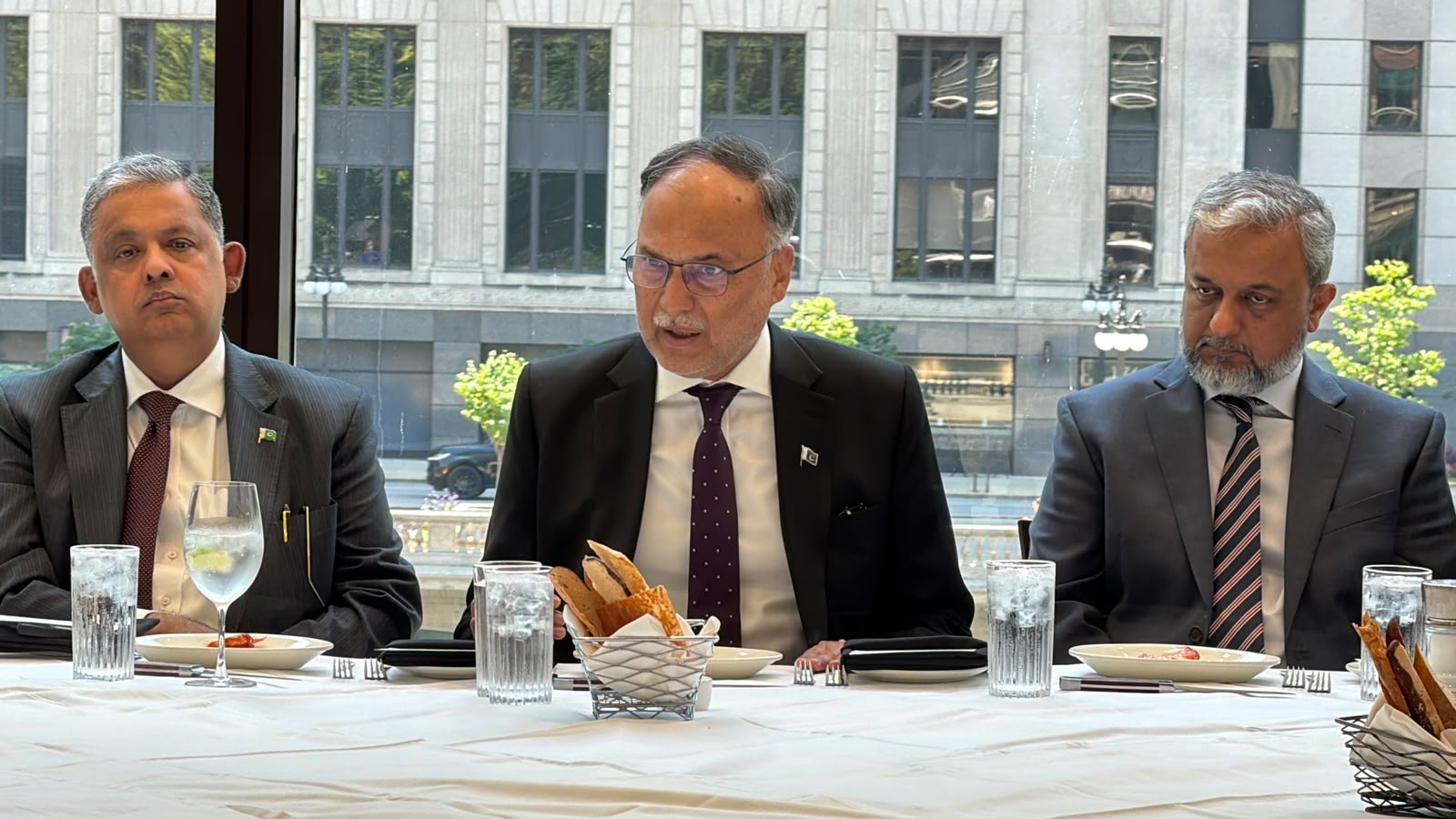
CHICAGO, Federal Minister for Planning, Development and Special Initiatives Ahsan Iqbal has invited Pakistani-American business leaders to play a leading role in Pakistan’s economic transformation, urging them to invest their capital, expertise and global networks in support of the country’s long-term development agenda.
Addressing a 20-member delegation comprising Fortune 500 executives, AI entrepreneurs, technology investors and business leaders in Chicago, the minister said Pakistan has reached a pivotal stage where recent gains in national security, diplomacy and macroeconomic stability must now be translated into sustainable economic growth.
He said the government, under the leadership of Prime Minister Shehbaz Sharif, had restored macroeconomic stability through difficult but necessary reforms, reducing inflation, easing policy rates and positioning Pakistan among the world’s leading economic turnaround stories. He stressed that overseas Pakistanis, particularly the Pakistani-American community, have excelled globally in technology, finance, healthcare, energy and academia, and their active participation is essential for Pakistan’s next phase of economic development.
Ahsan Iqbal said Pakistan’s constructive role in promoting regional peace has strengthened investor confidence and created new opportunities for trade and international partnerships. He encouraged overseas Pakistanis to include Pakistan in their investment and professional portfolios, noting that many members of the delegation were already contributing through investments and philanthropic initiatives.
The minister outlined the government’s URAAN-Pakistan vision, targeting a $1 trillion economy by 2035 and a $3 trillion economy by 2047, driven by the 5Es framework—Exports, E-Pakistan, Environment and Climate Change, Energy and Infrastructure, and Equity and Empowerment. He identified information technology, agriculture, manufacturing, tourism, mining and minerals, the blue economy, skilled manpower and creative industries as priority sectors for export-led growth.
He reaffirmed the government’s commitment to creating a business-friendly environment and strengthening Pakistan’s knowledge economy through partnerships with leading US academic institutions, including the University of Chicago, the University of Illinois Chicago, the Illinois Institute of Technology and the wider US-Pakistan Knowledge Corridor. He also highlighted ongoing efforts to engage overseas Pakistani experts in advancing Pakistan’s artificial intelligence capabilities and technological transformation.
During his visit, Ahsan Iqbal held three separate meetings with representatives of the University of Chicago, resulting in agreements to expand cooperation in public policy, education reform and climate resilience.
In a meeting with Professor Madhav Rajan and Professor Katie Hiranyak, both sides agreed to establish a hybrid academic programme allowing Pakistani students to complete coursework in Chicago and research in Pakistan. They also agreed to jointly design a public-sector transformation programme to modernise Pakistan’s civil service through advanced training in science, technology and contemporary governance practices.
In discussions with development economist Dr. Christina Brown and Research Director Zohaib Hassan, the two sides agreed to collaborate with the Pakistan Institute of Development Economics (PIDE) on comprehensive curriculum reforms aimed at modernising Pakistan’s education system and making learning more accessible by addressing language barriers.
The minister also met Sam Ori, Executive Director of the Institute for Climate and Sustainable Growth, where both sides agreed to deepen collaboration on emissions trading, expand research on electricity tariff reforms through a new memorandum of understanding with PIDE, and strengthen Pakistan’s weather forecasting and early-warning systems through specialised training.
The Chicago engagements concluded with both sides reaffirming their commitment to transforming cooperation in economic development, education, climate resilience and technological innovation into practical, long-term partnerships benefiting Pakistan’s sustainable growth.
