
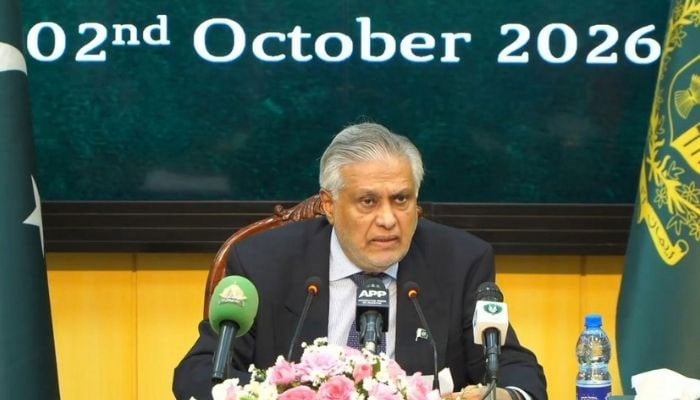
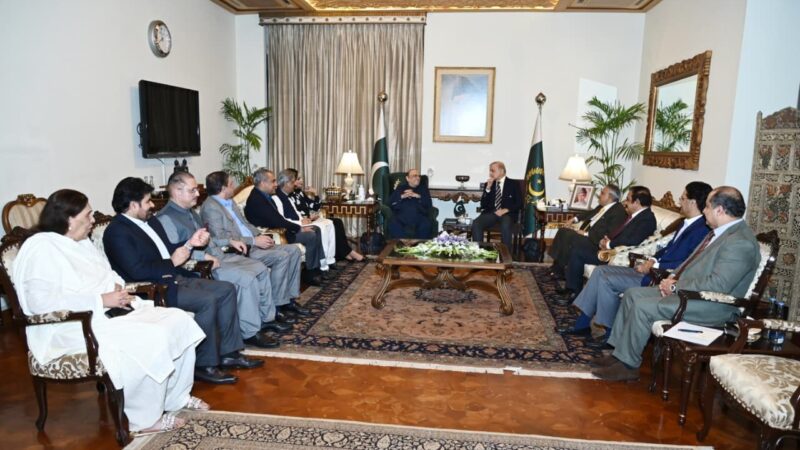
Islamabad- Deputy Prime Minister and Foreign Minister Senator Ishaq Dar has said that at least six Muslim countries have expressed keen interest in joining the Makkah Mukarramah Defence Pact.
However, he said, no new members could be considered until the pact’s secretariat becomes fully operational, a process that would take at least one year.
Dar said the agreement was defensive in nature and had no offensive agenda. He added that the document was open to other countries willing to accept the principles agreed upon by its three founding members — Pakistan, Saudi Arabia and Türkiye.
He clarified that any decision regarding the admission of new members would be taken jointly by Pakistan, Saudi Arabia and Türkiye, and Pakistan could not make such a decision independently.
The deputy prime minister said Prime Minister Shehbaz Sharif had also highlighted the threat of terrorism emanating from Afghanistan and the Houthi attacks against Saudi Arabia. He also credited Chief of Defence Forces Field Marshal Asim Munir with playing a role in the US-Iran mediation process.
Pakistan’s Role in Multilateral Diplomacy
Dar said Pakistan had played a full role in strengthening multilateralism during its presidency of the United Nations Security Council.
He said a resolution introduced by Pakistan on multilateralism and the peaceful settlement of disputes was adopted unanimously last year, marking the first such unanimous adoption on the issue in 12 years.
Speaking about US-Iran engagement, Dar said Pakistan had brought the two sides to the negotiating table for the first time in 47 years. He said six sessions were held over a combined 21 hours, eventually leading to a signing on June 18.
Energy Crisis and Fuel Relief
Addressing the energy crisis caused by disruptions around the Strait of Hormuz and Bab-el-Mandeb, Dar said the prime minister had highlighted the impact on supply chains and prices.
He said prices had almost doubled in Pakistan. Despite financial constraints and the IMF programme, however, the government approved a fuel relief scheme that is now benefiting millions of people using two-wheelers, three-wheelers and small four-wheelers with engines up to 800cc.
Dar said conflict could not provide a solution to international disputes. He noted that even after the World Wars, countries involved in conflicts ultimately had to sit together and establish institutions to address their differences.
Kashmir Policy
Replying to a question on Kashmir, Dar said Pakistan’s position was “absolutely clear”.
He said the people of Kashmir must be allowed to decide their future through a plebiscite in accordance with UN Security Council resolutions. He added that India’s actions of August 5, 2019, must be reversed and that no demographic change should be permitted in occupied Kashmir.
Dar said Pakistan was immediately blamed following the Pahalgam incident and India subsequently used the resulting sentiment to take further steps.
He said Pakistan’s Foreign Office did not allow India’s narrative to gain international acceptance and immediately offered an independent and neutral investigation.
Dar said that when India claimed to have carried out strikes at 15 locations and alleged that F-16 aircraft had been shot down, Pakistan challenged the claims and asked India to specify how many aircraft had actually fallen. According to Dar, India’s credibility was subsequently undermined.
Indus Waters Treaty
On the Indus Waters Treaty, Dar said Pakistan did not accept India’s decision to place the treaty in abeyance.
He said the country’s national security leadership as well as its civil and military leadership had resolved not to give up “even a drop” of Pakistan’s water, describing the country’s water resources as a trust belonging to 250 million Pakistanis.
Diplomatic Engagements on Gaza, Kashmir and Afghanistan
Dar said he attended a meeting of the Arab-Islamic group of eight countries on Gaza, hosted by Egypt.
He also participated in a regional four-nation meeting involving Pakistan, Saudi Arabia, Türkiye and Egypt, as well as a UN Security Council briefing on artificial intelligence.
He attended OIC Contact Group meetings on Jammu and Kashmir and Afghanistan, saying Pakistan had pushed for the Afghanistan meetings to be held regularly.
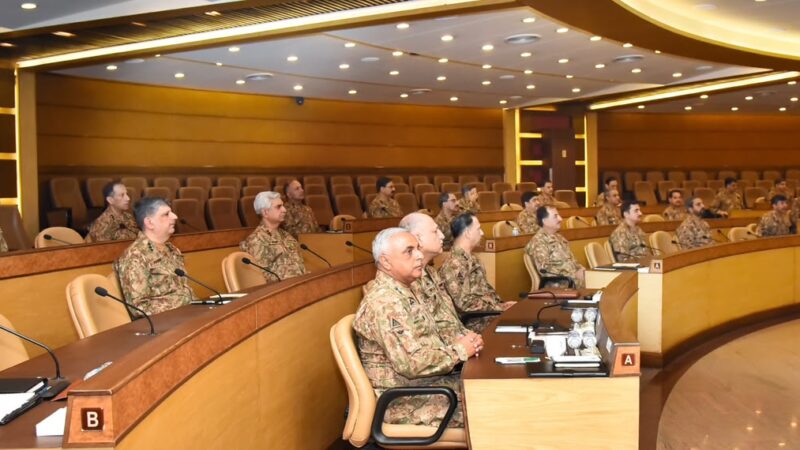
On the Makkah Defence Pact, Dar said the three foreign ministers had met in New York while the three army chiefs met in Riyadh. The accord was signed on August 7, followed by its first inaugural meeting in Istanbul on August 31.
He also attended a high-level meeting on pandemic prevention and preparedness and chaired the informal ECO Council of Ministers meeting on the sidelines of the United Nations on September 27.
Pakistan’s Position on Palestine
At a high-level international meeting on the two-state solution hosted by France and attended by the leaders of France, the United Kingdom and Canada, as well as Saudi Foreign Minister Prince Faisal bin Farhan, Dar reiterated Pakistan’s position on Palestine.
He said Pakistan supports the establishment of a Palestinian state on the pre-1967 borders, with Al-Quds Al-Sharif as its capital.
