
By Khawaja Hamza
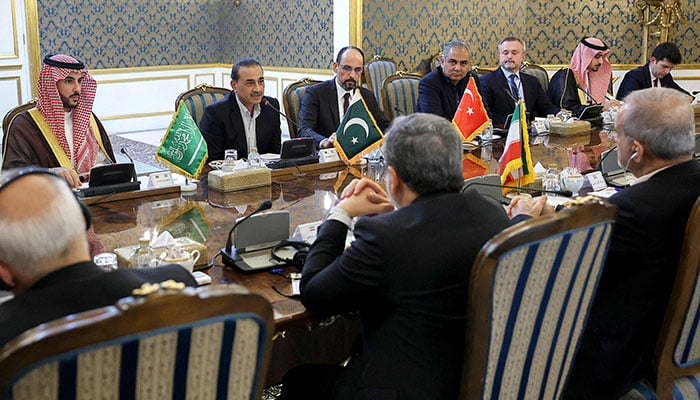
ISLAMABAD, Pakistan, Saudi Arabia, Türkiye and Iran have agreed to continue dialogue and strengthen regional cooperation to promote peace and security in West Asia, following a four-nation meeting in Tehran on Monday amid escalating regional tensions and ongoing diplomatic efforts to resolve the conflict involving Iran, the United States and Israel.
Chief of Defence Forces and Chief of Army Staff Field Marshal Syed Asim Munir participated in the meeting alongside Saudi Defence Minister Khalid bin Salman, Turkish intelligence chief Ibrahim Kalin and senior Iranian officials. The meeting was held at Pakistan’s request and hosted by Major General Mohsen Rezaei, secretary of Iran’s Supreme National Security Council. Iranian Foreign Minister Abbas Araghchi also attended the discussions.
According to Iranian state media, the talks focused on regional cooperation, the US-Israeli war against Iran and its consequences, Israeli activities across the region, and developments in Palestine and Lebanon. The participants agreed to continue dialogue to strengthen cooperation among the four countries, particularly in regional peace and security.
Following the meeting, Rezaei said the participating countries had agreed that regional security should be ensured by the countries of West Asia themselves, without external interference.
“We concluded that West Asia’s security must be based on the countries of the region, and any external interference must be prevented,” he said.
Rezaei said regional countries should have begun cooperating earlier, adding that the visits by Turkish, Pakistani and Saudi delegations to Tehran demonstrated the importance of regional engagement. He described the discussions as creating a new and positive atmosphere and said cooperation among the four countries could offer a way out of the crises confronting the region.
He also called on Israel to stop its attacks on Lebanon, southern Syria, the Gaza Strip and the West Bank.
The delegations subsequently met Iranian President Masoud Pezeshkian, who welcomed initiatives aimed at strengthening unity among Muslim countries and promoting constructive cooperation in West Asia.
Pezeshkian said Tehran supported any agreement that strengthened cooperation among Muslim nations, urging regional countries to prioritise shared interests and avoid allowing differences to obstruct common objectives. He also called for greater economic cooperation to enable countries in the region to meet one another’s needs and withstand external pressure.
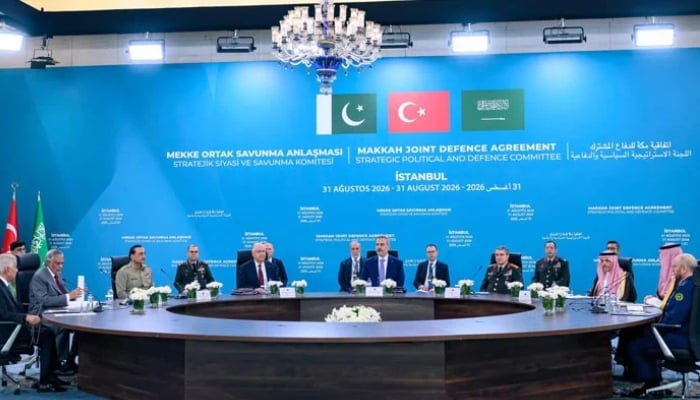
Earlier, Iranian Foreign Ministry spokesman Esmaeil Baghaei said the Tehran meeting, involving senior Iranian officials and representatives of the Makkah Alliance countries—Pakistan, Saudi Arabia and Türkiye—could mark the beginning of a regional security framework based on cooperation among countries of the region.
Pakistan Reaffirms Commitment to Regional Peace
Meanwhile, Defence Minister Khawaja Asif praised the peace talks in Iran, reaffirming Pakistan’s continued commitment to promoting regional peace and stability.
Speaking to a private television channel on Monday, Asif described Pakistan’s relations with Saudi Arabia as brotherly and cordial, emphasising that Islamabad remained committed to protecting its friendly countries, including the Kingdom of Saudi Arabia.
He highlighted the Makkah Joint Defence Agreement involving Pakistan, Saudi Arabia and Türkiye, stressing the need for practical measures by the participating countries to maintain peace and security.
The defence minister observed that conflicts have far-reaching consequences, adversely affecting the lives and livelihoods of ordinary people. He also appreciated the efforts of Prime Minister Shehbaz Sharif and Field Marshal Syed Asim Munir, saying their initiatives had contributed to international efforts aimed at achieving peace and stability.
Saudi Deputy Minister for Public Diplomacy Dr Rayed Krimly confirmed that Saudi Defence Minister Khalid bin Salman was leading a delegation to Tehran as part of continued efforts by countries party to the Makkah Joint Defence Agreement to promote de-escalation.
In a post on X, Krimly said the visit was intended to encourage dialogue and diplomatic solutions in support of mediation efforts by Qatar and Pakistan.
Regional Conflict and Diplomatic Challenges
The Tehran talks took place amid continuing regional tensions following US-Israeli attacks on Iran in late February, which triggered a wider conflict and disrupted global markets and international energy trade.
The conflict led to restrictions on shipping through the strategically important Strait of Hormuz, a major route for global oil and liquefied natural gas supplies. Approximately one-fifth of the world’s oil and liquefied natural gas previously transported by sea passed through the waterway.
An April ceasefire brought an end to the initial phase of intense bombardment, but disputes over control of the strait have continued. Iran maintains control over the waterway and has regularly targeted vessels attempting to cross without its authorisation, while the United States has imposed a naval counter-blockade on Iranian ports.
The conflict has also spread across the region, including fighting involving Saudi Arabia and Yemen’s Houthi movement, which has carried out attacks on airports and oil facilities in the kingdom.
Diplomatic efforts to resolve the crisis remain stalled, particularly following the collapse of a June agreement intended to establish a pathway towards a permanent settlement.
The four-nation meeting in Tehran represents a renewed diplomatic effort to strengthen regional coordination, address shared security concerns and reduce tensions through dialogue. Pakistan, Saudi Arabia, Türkiye and Iran have signalled their willingness to continue consultations, with an emphasis on regional ownership of security arrangements, economic cooperation and diplomatic solutions to the crises confronting West Asia.
