
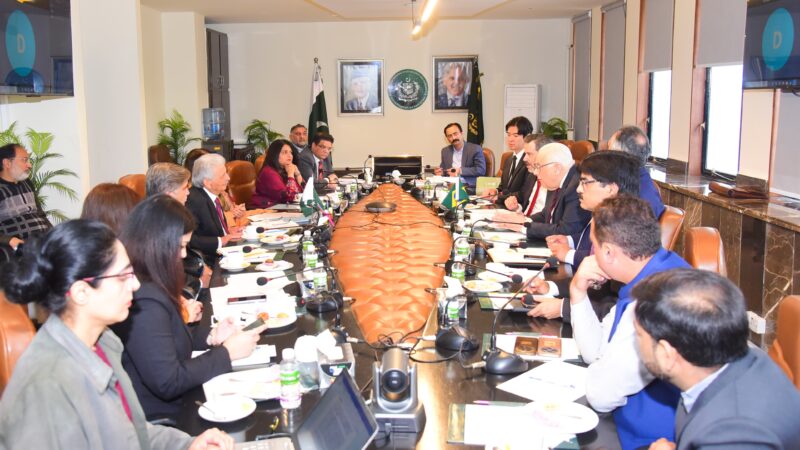

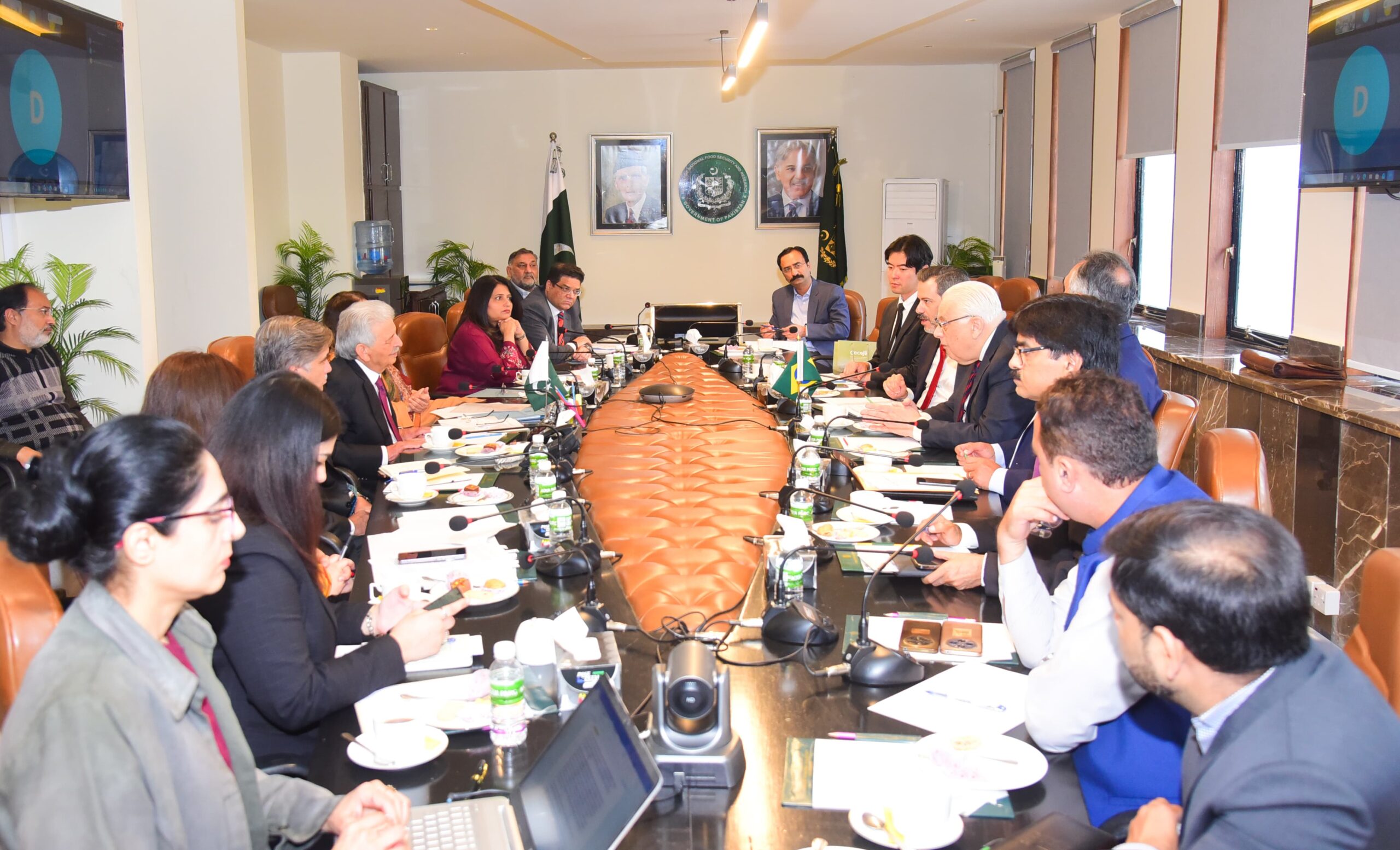
Islamabad, Federal Minister for National Food Security and Research, Rana Tanveer Hussain, held a meeting with a high-level Brazilian delegation led by Ambassador Rafael Guimarães Requião, Deputy Secretary for Trade and International Relations, to explore opportunities for expanding bilateral agricultural trade, modernizing livestock production, strengthening research collaboration and promoting investment in fisheries and aquaculture.
The delegation included the Director of the Department of Non-Tariff Negotiations and representatives of Brazilian private-sector associations. Senior officials of the Ministry and Chairman Pakistan Agricultural Research Council (PARC) and Animal Husbandry Commissioner, Dr. Syed Murtaza Hassan Andrabi, also attended the meeting.
Highlighting bilateral trade exceeding USD 1 billion during FY 2024-25, Rana Tanveer Hussain emphasized the need to diversify trade, ensure reciprocal market access and establish stronger commercial and institutional partnerships between the two countries.
The Federal Minister identified livestock modernization as a major area of cooperation, acknowledging Brazil’s expertise in cattle breeding, livestock management and halal meat exports. He highlighted the enormous untapped potential of Pakistan’s largely informal livestock sector and expressed interest in adopting Brazilian technologies and production models to transform it into a competitive, export-oriented industry.
Pakistan highlighted its efforts to establish four Foot-and-Mouth Disease (FMD) control zones, supported by further compartmentalization, drawing on Brazilian experience. The Federal Minister also stressed the early operationalization of the Pakistan–Brazil Joint Working Group on Livestock and Dairy Cooperation, particularly through the establishment of an export-oriented slaughterhouse with an integrated feedlot system and a modern dairy cluster.
The meeting reviewed two pending project proposals under the South–South Cooperation framework concerning genomic-based livestock improvement and the establishment of FMD-free zones and compartments. Pakistan sought their early formalization to accelerate institutional and technical cooperation.
The Brazilian side proposed incorporating internationally recognized zoning and compartmentalization provisions into veterinary health certificates for poultry and hatching eggs to prevent localized disease outbreaks from disrupting trade from disease-free regions. Opportunities for trade in animal by-products, feed ingredients and other livestock products were also discussed, subject to applicable sanitary requirements.
In the crops sector, Rana Tanveer Hussain highlighted Pakistan’s recently announced GMO policy and opportunities for cooperation in biotechnology, particularly cotton. Referring to the decline in domestic cotton production to approximately 5.6 million bales, he emphasized the importance of improved seed quality, advanced breeding technologies and high-yielding varieties in reviving cotton productivity.
The Federal Minister welcomed the completion of regulatory procedures for GM soybean imports from Brazil and called for early submission of the pending technical information concerning cotton seed imports. Cooperation in seed germplasm exchange and varietal improvement, particularly in maize, soybean and sugarcane, was also discussed.
Pakistan expressed interest in expanding exports of Basmati rice, mangoes, dates, citrus fruits, potatoes, guava, pink salt and medicinal plants to Brazil. The Brazilian side indicated that the necessary regulatory requirements for rice trade had already been fulfilled, allowing commercial trade to commence without further regulatory negotiations.
Both sides emphasized direct engagement between their respective plant protection authorities to resolve outstanding phytosanitary issues and expedite market access. Discussions also covered the commercial competitiveness of Brazilian pulses and opportunities for value addition through soybean processing and poultry and livestock feed production.
In the fisheries sector, Rana Tanveer Hussain invited Brazilian investment in commercial shrimp farming, particularly in Punjab and Sindh. He proposed developing an integrated aquaculture value chain encompassing hatcheries, feed production, farming, processing and cold-chain infrastructure. The establishment of a Pakistan–Brazil Public–Private Working Group on Fisheries and Aquaculture was also proposed to facilitate joint ventures and seafood market access.
The delegation’s visit programme also included technical sessions and visits to selected research facilities at the National Agricultural Research Centre (NARC), Islamabad, focusing on agricultural research, seed development, phytosanitary market access, livestock cooperation and aquaculture investment.
The successful organization of the food and agriculture exhibition in Karachi, attended by delegations from around 70 countries, was also appreciated, along with the efforts of the Trade Development Authority of Pakistan (TDAP) and other relevant institutions.
The meeting concluded with an emphasis on translating bilateral engagement into concrete projects through reciprocal market access, regulatory facilitation, technology transfer, research partnerships and private-sector investment.
Rana Tanveer Hussain reaffirmed Pakistan’s commitment to building a productive, technologically advanced and export-oriented agricultural sector, with international cooperation playing a pivotal role in ensuring food security, economic growth and farmers’ prosperity.
