



Islamabad, Pakistan today celebrated a monumental achievement in space technology with the successful launch of its fourth Earth Observation Satellite, developed in close collaboration with its longstanding partner, China.
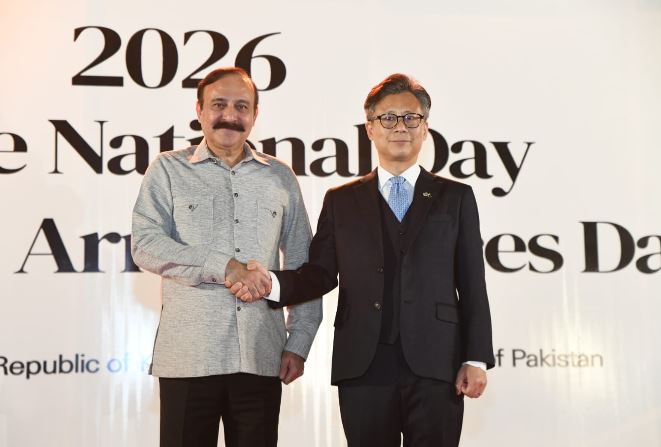
The launch ceremony was graced by Prof. Ahsan Iqbal, Federal Minister for Planning, Development and Special Initiatives, who attended as Chief Guest. Addressing the gathering, the Minister declared, “This is not merely a technological milestone—it is a moment that lifts our national spirit and elevates our friendship with China higher than the skies.”
Minister Iqbal elaborated: “Today, we are not just launching a satellite; we are launching a vision—a vision of Pakistan rising as a leader in space science, powered by innovation, strengthened by partnerships, and driven by an unshakable belief in our destiny at the forefront of technology and exploration.”
Looking ahead, the Minister reaffirmed Pakistan’s ambitious goal of landing a spacecraft on the Moon by 2035, saying this mission will inspire our youth, attract global talent, and position Pakistan as a significant player in the international space economy.
He reflected on Pakistan’s rich space legacy: “Since the founding of SUPARCO in 1961, Pakistan has been one of the first developing nations to embrace space research. From Badr‑1 in 1990 to PakTES‑1A in 2018, and PAKSAT‑1R in 2011 to Paksat‑MM1 in 2024, we have steadily advanced our capabilities. This new satellite is the next chapter in that journey.”
Drawing on the symbolic strength of Pakistan–China friendship, he noted: “From the Karakoram to the coasts of Gwadar, our friendship is higher than the Himalayas, deeper than the oceans, and sweeter than honey.” With today’s launch, “Our iron brotherhood now soars higher than the skies.”
Minister Iqbal also underscored how collaboration through CPEC has reshaped Pakistan’s infrastructure and economy—now extending into space: “This mission is a shining example of how the spirit of CPEC is evolving from roads and energy into joint exploration and technological excellence.”
He emphasized the satellite’s benefits:
Enhancing imaging and remote sensing capabilities
Strengthening disaster response, food security, and urban planning
Enabling data-driven policymaking for socio‑economic uplift
Symbolizing the Pakistan–China iron brotherhood beyond Earth
The Minister thanked Pakistani and Chinese partners—especially BOMETEC, CETC International, and MicroSAT—praising the project as a government‑to‑government success delivered with exceptional speed and precision.
Highlighting the vast potential ahead, he noted that the global space economy is projected to exceed $1 trillion by 2040. With China’s support and Pakistan’s growing expertise, he outlined a roadmap to:
Expand the satellite constellation for comprehensive Earth observation
Increase investment in space research and STEM education to empower youth
Launch joint space missions, aiming for a Pakistani lunar landing by 2035
Build a robust space industry ecosystem contributing to economic growth and innovation
“To every engineer, scientist, and team member—this milestone is your triumph,” he said. “Pakistan–China friendship is not limited to borders or oceans; it now extends into outer space. This satellite is a symbol of hope and ambition for the people of Pakistan.”
Minister Iqbal concluded: “Great nations don’t just dream of the stars—they build the rockets to reach them. With innovation as our compass, collaboration as our engine, and determination as our fuel, Pakistan and China will together touch the Moon, explore Mars, and unlock the limitless opportunities of the universe.”
