
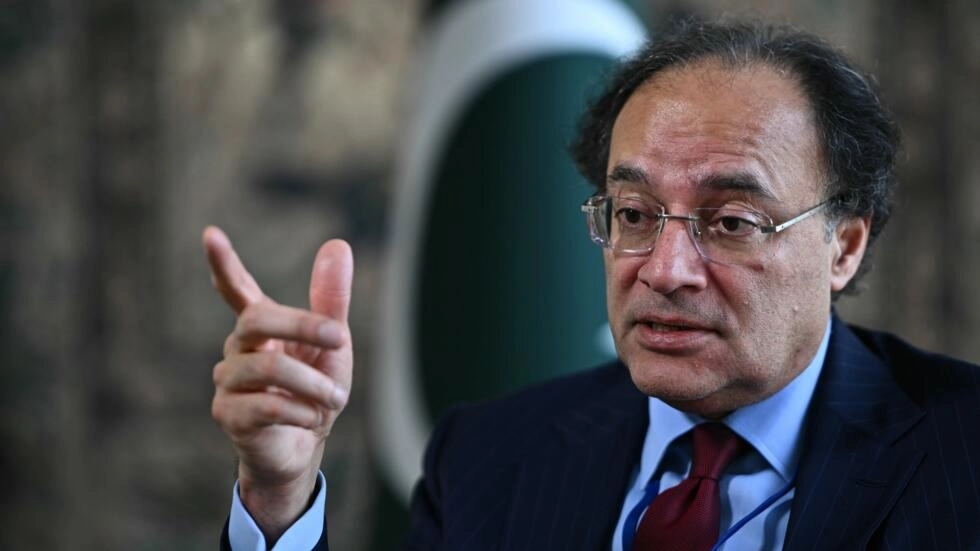
ISLAMABAD, Defying global uncertainty, devastating floods and regional tensions, Pakistan’s economy rebounded with a robust 3.7 per cent GDP growth in fiscal year 2025-26, showcasing resilience and disciplined economic management, Federal Minister for Finance and Revenue Senator Muhammad Aurangzeb said on Thursday.
Unveiling the Economic Survey of Pakistan 2025-26, he said the country stayed firmly on its path from stabilization to growth despite multiple external shocks, reflecting renewed confidence in the economy.
The minister, accompanied by Federal Minister for Planning, Development and Special Initiatives Professor Ahsan Iqbal, Federal Minister for Information and Broadcasting Attaullah Tarar, Minister of State for Finance and Revenue Bilal Azhar Kayani and senior officials from the Ministry of Finance and Revenue, highlighted key economic indicators and performance.
“The survey is not just an economic document but a story of resilience shown over the past year,” Aurangzeb said, adding that Pakistan remained steadfast on its journey from stabilization to growth.
He said that the fiscal year began with global trade uncertainty due to tariff-related issues, followed by devastating floods in August and September and later a regional conflict. “These exogenous factors tested Pakistan’s resilience, and we responded effectively while maintaining our growth trajectory,” he remarked.
Despite these challenges, the country recorded its highest GDP growth in four years. He recalled that the economy had contracted by 0.2 per cent in 2023, followed by growth of 2.6 per cent in 2024 and 3.2 per cent in 2025.
Aurangzeb said Pakistan’s economic size reached a historic level of Rs126.9 trillion, equivalent to $452.1 billion, while per capita income increased to $1,901 from $1,751 last year.
He said the growth was broad-based, with agriculture expanding by 2.89 per cent despite flood-related losses. The crop sector returned to positive growth while livestock, contributing around 60 per cent to agricultural GDP, continued to perform strongly, he added.
The industrial sector, he said, also showed significant improvement, with large-scale manufacturing growing by 6.1 per cent, the highest in four years. Out of 22 manufacturing sectors, 16 recorded positive growth, including food, textiles, automobiles, petroleum products and electrical equipment.
On the demand side, he pointed to strong consumption trends, including a 10 per cent increase in cement demand, 17 per cent in fertilizer, 31 per cent in automobiles and notable growth in petroleum and mobile phone usage.
The services sector remained a key driver of the economy, growing by 4.9 per cent and contributing nearly 58 percent to GDP. Information and communication services recorded a remarkable 7.52 per cent growth, reflecting the expanding role of the digital economy.
Highlighting fiscal consolidation, the minister said the fiscal deficit was reduced to 0.7 per cent of GDP from 2.6 per cent last year, while primary surplus improved. Federal Board of Revenue collections increased by 10.1 percent and markup payments declined by 23 per cent, creating additional fiscal space, he added.
“Despite global slowdown, where growth declined to 3.1 per cent, Pakistan has outperformed expectations,” Aurangzeb said, reiterating the government’s commitment to sustaining inclusive and broad-based economic growth.
The Fnance Minister, Muhammad Aurangzeb, while highlighting industrial performance, said the industrial sector recorded 3.51 percent growth, driven mainly by a 6.11 percent expansion in Large-Scale Manufacturing (LSM). Manufacturing activities were supported by macroeconomic stability, a stable exchange rate, easing inflationary pressures and improved business confidence.
The finance minister said the services sector, which accounts for over 58 percent of GDP, expanded by 4.09 percent, led by strong growth in information and communication services.
On fiscal performance, Aurangzeb said the fiscal deficit narrowed sharply to 0.7 percent of GDP during July-March FY2026 from 2.6 percent a year earlier, while the primary surplus improved to 3.2 percent of GDP. Total revenues increased by 10.7 percent to Rs14.8 trillion, supported by growth in both tax and non-tax revenues.
He said inflation remained largely under control during most of the fiscal year, although international oil price increases and supply disruptions resulting from the Middle East crisis exerted pressure in recent months. Average inflation during July-April stood at 6.2 percent.
On the external front, the minister said the current account posted a surplus of $72 million during July-March FY2026, while workers’ remittances increased by 8.2 percent to $30.3 billion. Foreign exchange reserves rose to $21.8 billion by the end of March 2026, helping maintain exchange rate stability.
He said the country’s capital markets performed strongly, with the benchmark KSE-100 Index gaining 18.4 percent during the period under review, supported by improving macroeconomic indicators, lower inflation and investor confidence.
The minister said Pakistan’s information technology sector continued to emerge as a key growth driver. ICT export remittances increased by 19.7 percent to $3.38 billion, while freelance exports surged by 51 percent to $856 million. The successful 5G spectrum auction generated around $510 million and marked a significant step in the country’s digital transformation.
Aurangzeb said significant progress was also recorded in social sectors. Literacy improved to 63 percent, school attendance increased to 67 percent and the proportion of out-of-school children declined considerably across the country. Life expectancy rose to 67.8 years, while immunization coverage improved to 73 percent.
He said the government remained committed to strengthening social protection programmes, promoting inclusive growth, creating employment opportunities and improving living standards. Pro-poor expenditures reached Rs4.66 trillion during the fiscal year, while initiatives under BISP and other welfare programmes continued to support vulnerable segments of society.
Referring to climate challenges, the minister said Pakistan remained among the countries most vulnerable to climate change despite contributing less than one percent to global emissions. The 2025 floods caused damages worth Rs822 billion and affected millions of people, underscoring the need for greater climate resilience and sustainable development.
He said the government would continue structural reforms aimed at maintaining macroeconomic stability, enhancing exports, attracting investment, improving productivity and ensuring sustainable and inclusive economic growth in the years ahead.
Economy part 2
Elaborating on details, Minister for Finance and Revenue Senator Muhammad Aurangzeb said the recovery in large-scale manufacturing was broad-based, with 16 sectors posting positive growth, including food, textiles, wearing apparel, petroleum products, non-metallic minerals, automobiles, beverages and electrical equipment.
The minister said exports of value-added products continued to perform well despite global challenges. During July-May FY2026, exports of woven garments increased by 5 percent, home textiles by 3 percent and knitted garments by 3 percent, while sports goods exports recorded an 18 percent increase.
He said Pakistan’s football continued to be used in major international tournaments, reflecting the competitiveness of the country’s sports goods industry.
Highlighting investment trends, Aurangzeb said Roshan Digital Account inflows had increased significantly, rising from an average of $180-190 million per month to over $322 million in April, with similar levels expected in May.
He said these investment-led inflows were supporting sectors such as housing, capital markets and government-backed investment instruments.
The minister said the investor base in the equity market had crossed 563,000, with around 175,000 new investors entering the market during the year. More than 39,000 new companies were registered, nearly all through digital channels, taking the total number of registered companies in the country to around 300,000. He added that 11 initial public offerings (IPOs) were completed during the year, indicating growing business confidence and expansion plans in the corporate sector.
Aurangzeb said several international firms, including Google, BYD, Aramco, Alibaba Group, AD Ports, Nestlé, Mashreq and Turkish Petroleum, had either entered Pakistan or expanded their investments, reflecting renewed investor confidence in the country’s economic prospects.
On debt management, he said the public debt-to-GDP ratio had declined from 75 percent in 2023 to 68.5 percent in FY2026. He added that Pakistan had successfully diversified its financing sources through Panda Bonds and Shariah-compliant Sukuk, while active liability management measures helped reduce debt-servicing costs and refinancing risks.
Referring to tax reforms, the minister said digital production monitoring in the cement and sugar sectors generated around Rs60 billion in additional revenue, while AI-based audit selection and risk-based compliance measures yielded another Rs34 billion, demonstrating the effectiveness of technology-driven reforms in revenue administration.
Responding to a query, he said the government was addressing three key concerns, including taxation, energy costs and financing through policy interventions, structural reforms and targeted subsidies.
Replying to another question on financing costs, he said these had been on a downward trajectory before recent external shocks.
However, imported inflation driven by higher petroleum prices temporarily reversed the trend, though the overall direction remained positive.
He added that six to seven subsidized schemes, including agriculture and housing finance, were being introduced, offering low, fixed rates for up to 10 years.
On taxation, the minister said details would be unveiled in the budget.
To a query on energy, he highlighted reduced industrial tariffs following the gradual removal of cross-subsidies and ongoing power sector reforms, including privatization of distribution companies.
He said stakeholder consultations reflected growing confidence but stressed the need to raise investment levels to the high teens of GDP.
The minister further identified regulatory bottlenecks and policy inconsistency as key challenges, emphasizing ease of doing business and stable policies to boost exports.
He added that while immediate external shocks were managed effectively, their secondary impacts on inflation and energy were being closely monitored.
Answering a question, Minister for Planning, Development and Special Initiatives Professor Ahsan Iqbal said it was unfortunate that Pakistan had failed to adopt an export-led growth model over the past seven decades, terming it a key structural weakness of the economy.
He said globally successful economies achieved sustained growth through exports, contrasting that overseas Pakistanis, around nine million, contribute about $40 billion annually, while 250 million citizens generate a similar amount through exports.
He said this imbalance forced reliance on stop-gap arrangements, including commercial borrowing, multilateral financing and bilateral support, instead of building a self-sustaining external sector.
Responding to concerns about external dependence, he stressed the need to transition from borrowing to export-led growth, reduce non-essential imports and enhance foreign direct investment, noting that countries like Vietnam attract significantly higher inflows despite smaller populations.
He said economic transformation required a “test match” approach rather than short-term fixes, urging stability and sustained policy implementation.
Ahsan Iqbal stressed the need to shift towards rapid growth, saying that with a large youth population, “crawl is no longer an option,” and Pakistan must “leapfrog” through structural reforms and a positive economic outlook.
