

By Qamar Bashir
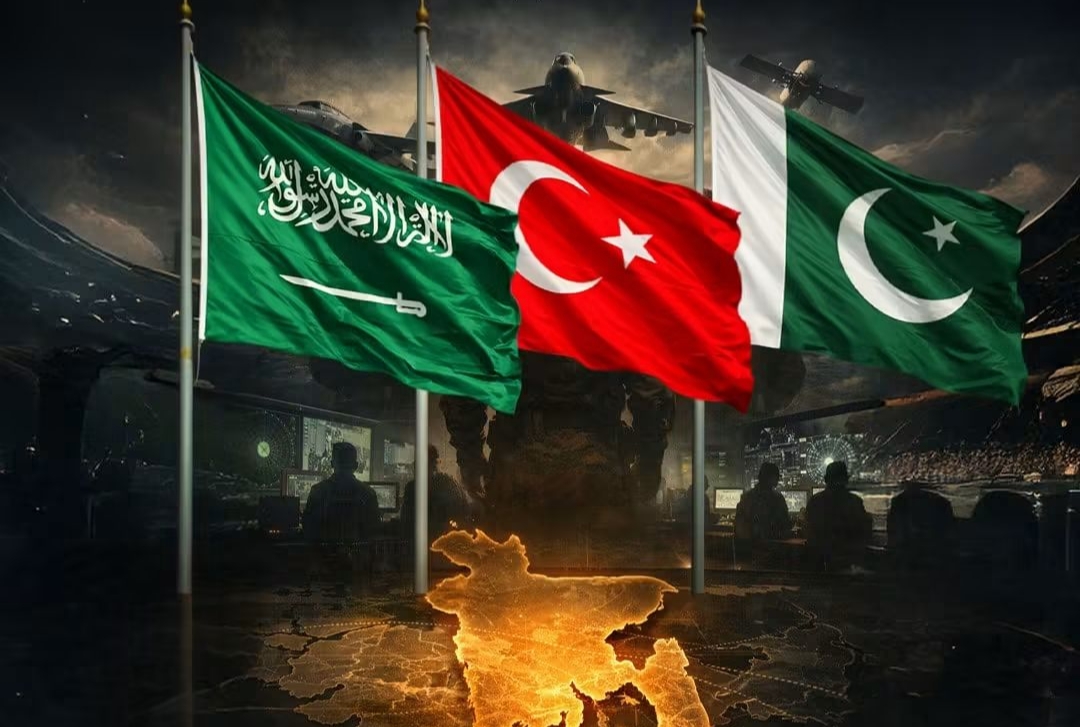
One of the most consequential outcomes of the Iran war has been the emergence of new security arrangements across the Middle East and its surrounding regions. Among them, the Makkah Joint Defence Agreement between Saudi Arabia, Pakistan and Türkiye deserves particular attention. Yet describing this arrangement as an “Islamic NATO” is misleading, unnecessarily provocative and potentially dangerous. It converts a developing defensive arrangement among three sovereign states into an ideological and religious bloc that its signatories themselves have not formally created.
The agreement signed in Makkah on August 7 is certainly significant. Saudi Arabia, Pakistan and Türkiye have committed themselves to collective deterrence, including the important principle that an armed attack against one will be regarded as an attack against all three. Their official statement speaks of historical ties, Islamic solidarity, shared strategic interests and defence cooperation. But its declared objectives are collective security, deterrence, peace and regional stability. It is formally called the Makkah Joint Defence Agreement—not Islamic NATO.
That distinction matters. Calling it an Islamic NATO immediately injects religion into what should primarily be understood as a strategic security arrangement. If this alliance must be called “Islamic NATO” because its three members are Muslim-majority countries, should NATO itself be described as “Christian NATO” because most of its members historically have Christian-majority populations? Clearly not. Modern alliances are normally defined by strategic interests, geography and shared security concerns rather than the religions practiced by their populations.
The Makkah agreement should therefore be viewed in the extraordinary geopolitical environment from which it emerged. The Iran war has profoundly disturbed assumptions about security across the Middle East. Countries that once believed distant great powers could guarantee their security have been forced to reconsider how much strategic autonomy they require. Old relationships have been tested, new partnerships accelerated and previously improbable security arrangements have become conceivable.
The transformation is especially visible in Syria. Türkiye’s growing influence there has increasingly intersected with Israel’s security calculations. Israeli strikes, Turkish objections and disputes over possible Turkish military activity have created an entirely new potential flashpoint. An Israeli strike on Syria’s Abu al-Duhur airbase this month produced sharp exchanges between Ankara and Israel, while Washington has been attempting to establish mechanisms preventing their competition inside Syria from escalating into direct confrontation.
Only days later, Syria and Israel were again engaged in American-mediated talks intended to reduce tensions, including the danger that Israeli-Turkish rivalry could spill further into Syrian territory. This illustrates just how dramatically the regional chessboard has changed: Syria is no longer merely an arena of the old Iran-Israel confrontation but increasingly a junction where Turkish, Israeli, Syrian, Arab and American security interests overlap.
The war has simultaneously returned the Palestinian question to the centre of regional diplomacy and exposed tensions within relationships previously regarded as almost immune from strategic disagreement. It has forced governments from the Gulf to South Asia to reconsider whether traditional bilateral security relationships remain sufficient in an era of missiles, drones, cyberwarfare, disrupted shipping and rapidly shifting alliances.
The consequences extend far beyond military affairs. The Strait of Hormuz has demonstrated once again how vulnerable the global economy remains to Middle Eastern conflict. At the other end of the Arabian Peninsula, insecurity around the Red Sea and Bab el-Mandeb has reinforced the same lesson. Energy security can no longer be separated from military security. Importing nations consequently have powerful incentives to diversify suppliers, shipping routes, strategic reserves and transportation infrastructure.
Meanwhile, the United States itself is confronting growing fiscal pressure. Federal debt crossed $40 trillion in August, according to Treasury data. Long-term borrowing costs have also risen sharply The 10-year Treasury yield recently stood around 4.7%, while the 30-year moved above 5%. The average American 30-year fixed mortgage is approximately 6.7%. These are nevertheless painful levels for households purchasing homes and for businesses financing investment.
War expenditure, energy prices, inflation expectations, fiscal deficits and debt-servicing costs can therefore reinforce one another. The geopolitical struggle is not taking place separately from economics; economics increasingly constitutes another battlefield.
The international financial system is undergoing change as well. BRICS members and other countries have increasingly explored settlements using national currencies and alternative payment mechanisms. This greater diversification could gradually reduce Washington’s extraordinary ability to translate control over financial networks into geopolitical leverage.
This wider transformation helps explain why the Makkah agreement has attracted so much attention. Pakistan contributes nuclear deterrence, a large professional military and substantial operational experience. Türkiye possesses NATO’s second-largest military and a rapidly expanding indigenous defence industry. Saudi Arabia contributes immense financial capacity, strategic geography and political weight in both the Arab and Islamic worlds. Together they represent a potentially formidable combination.
But potential should not be confused with maturity. NATO has existed for more than seven decades. It possesses integrated military planning, command structures, interoperability standards, intelligence-sharing mechanisms, permanent institutions and decades of combined exercises. The Makkah arrangement is at the beginning of its institutional development. Treating the two as equivalent therefore exaggerates the capabilities of the new agreement while simultaneously misrepresenting its purpose.
Indeed, serious strategic analysis has described the agreement as evidence of a broader regional realignment while also emphasizing unresolved questions about how its collective-defence commitment would operate in practice.
Its members should now remove those ambiguities. Saudi Arabia, Pakistan and Türkiye should publicly define the agreement’s defensive character, institutional mechanisms and geographical scope. They should make clear that it is directed neither against Iran nor Israel, neither against the United States nor Europe, and certainly not against Christianity, Judaism or any other religion. Where their strategic interests permit, cooperation with additional states should be based on common security requirements rather than religious identity.
If Muslim states someday wish to construct an explicitly religion-based collective security architecture, the logical political forum for debating such an undertaking would be the Organization of Islamic Cooperation. The Makkah agreement is something different: a strategic defence arrangement among three sovereign countries responding to an increasingly unstable security environment.
That distinction must be protected. The Iran war has accelerated changes already developing throughout the international system: greater strategic autonomy, new regional partnerships, competition over energy corridors, pressure on American fiscal power, experimentation with alternative financial arrangements, new tensions surrounding Syria and reassessment of traditional security guarantees. The Saudi-Pakistan-Türkiye agreement belongs within this much larger geopolitical transformation.
Branding it an “Islamic NATO” reduces that complicated strategic evolution to religion. Worse, it risks manufacturing the very confrontation the agreement should help prevent—an imaginary world of Muslim alliances confronting Christian or Jewish alliances.
The international media should exercise the same responsibility. The Makkah Joint Defence Agreement deserves scrutiny, debate and even criticism. But it should be judged by its provisions, capabilities and conduct—not assigned a religious identity that its official name does not carry.
The world already has enough geopolitical fault lines. It does not need another one manufactured between religions.
