


ISLAMABAD: Afghanistan’s Ambassador to Pakistan, Sardar Ahmad Shakeeb, has called for a pragmatic and diplomatic approach to Pakistan-Afghanistan relations, saying the two countries must learn to manage their deep interdependence as good neighbors rather than allowing it to become a source of confrontation.
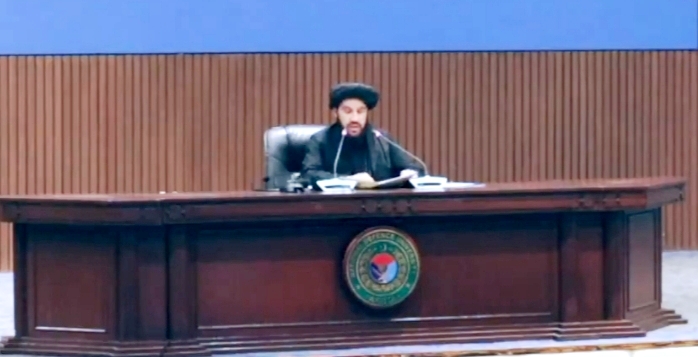
Addressing the National Defence University (NDU) in Islamabad, Ambassador Shakeeb said Afghanistan and Pakistan were not simply neighboring countries. Their geographies were interconnected, their peoples and societies had deep-rooted ties, and their histories were intertwined in many respects. He said trade, transit and the movement of people connected the two countries, while decades of wars and security developments had also made their security calculations closely linked.
He said political, security and economic developments in Afghanistan affected Pakistan, just as developments in Pakistan affected Afghanistan. This interdependence, he said, was a geographic and strategic reality that neither side could change. However, both countries could choose whether to view it as a source of crisis or turn it into an opportunity for stability, security and shared economic interests.
The Afghan envoy urged both countries to move beyond what he described as outdated perceptions of each other. He said present-day Afghanistan should not be assessed through the lens of the past several decades, emphasizing that it was neither the Afghanistan of the Cold War, the 1990s, nor the post-2001 period characterized by direct foreign military presence and political involvement. He said a new political reality had emerged in Kabul after 2021.
Addressing Pakistan’s security concerns, Shakeeb said Afghanistan fully understood Islamabad’s concerns about potential threats emanating from Afghan territory. At the same time, he stressed that security-related allegations should be specific, precise and supported by concrete information, identifiable individuals, specific networks and particular cases.
He said Afghanistan did not want its soil to be used against Pakistan. However, Kabul could not accept Pakistan’s security concerns becoming a justification for military action on Afghan territory. If Pakistan expected Afghanistan to cooperate over specific security concerns, he said, Afghanistan also wanted direct engagement with Pakistan regarding its own security concerns.
The ambassador said both countries had their own national interests and that being neighbors did not require either state to endorse all of the other’s strategic choices. Instead, he said, both sides should be able to take independent decisions while respecting each other’s legitimate security and national concerns.
Shakeeb further stated that Afghanistan’s relationship with one country should not automatically be interpreted as a position against another country. He said an independent state could maintain relations with several countries, including countries that did not have good relations with one another, without its relationship with one being regarded as hostility toward another.
He said Afghanistan had continued to make progress despite the regional crisis, the closure of routes by Pakistan and the arrival of millions of returnees. According to the ambassador, Afghanistan’s political and economic partnerships across the region had expanded, confidence had increased, and the country was moving away from the externally dependent economic model of the 20-year occupation.
He said Afghanistan had instead laid and strengthened the foundations of what he described as a genuine and sustainable national economy.
The Afghan ambassador outlined four things Afghanistan did not want: external pressure concerning its sovereignty and internal affairs; military action becoming a substitute for diplomatic engagement; collective punishment of Afghan citizens as a means of resolving security problems; and the use of trade and transit as instruments of political pressure.
Concluding his address, Shakeeb said neither Afghanistan nor Pakistan could change their geography and the two countries would remain neighbors.
“Therefore, the real question is not whether we will have relations with each other. The real question is: How will we remain good neighbors?” he said.
He added that Afghanistan was ready for such a choice—not from a position of weakness, dependency or confrontation, but as an independent state that knew its history, understood its geography, learned from its past experiences and sought to build its future according to the will of its people and national interests.
