
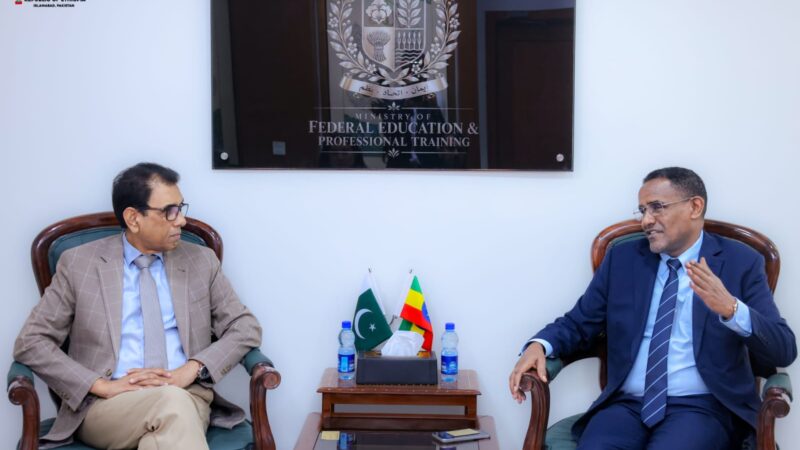
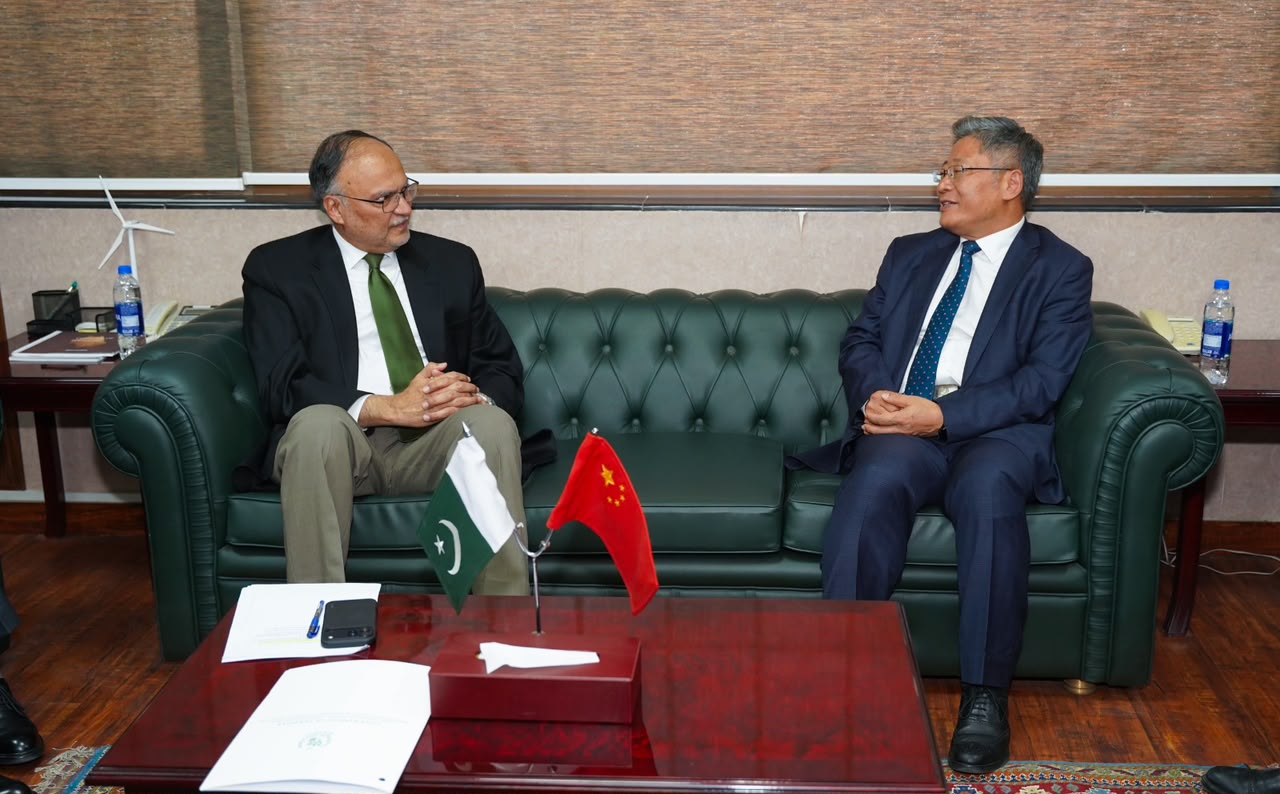
ISLAMABAD, August 11, 2026: A high-level Chinese delegation led by Sun Dongsheng, Senior Advisor, Economic Affairs Press, visited the CPEC Secretariat at the Ministry of Planning, Development and Special Initiatives and held detailed consultations with Federal Minister for Planning, Development and Special Initiatives Prof. Ahsan Iqbal, senior policymakers and development experts on advancing business-to-business (B2B) and industrial cooperation under CPEC 2.0.
During the consultations, Minister Ahsan Iqbal briefed the Chinese delegation on Uraan Pakistan, the government’s national economic transformation agenda, and proposed active collaboration with Chinese counterparts at the National Center of New Manufacturing to benefit from China’s experience in innovation, automation and robotics for Industrial Revolution 4.0 and 5.0.
The minister said Pakistan’s biggest economic challenge was its low export base, which had caused several economic take-offs to lose momentum. He emphasized that the government’s top priority was to transform Pakistan’s productive sectors into strong engines of exports and sustainable economic growth.
Iqbal said China had helped Pakistan overcome its energy deficit under CPEC Phase I, and expressed the hope that CPEC 2.0 would help Pakistan overcome its export deficit by promoting industrialization, productivity and greater access to international markets.
He particularly emphasized the need to facilitate Pakistani exports to China, pointing out that China imports nearly $2.6 trillion worth of goods annually, whereas Pakistan’s share of exports to the Chinese market remains very small at around $3 billion.
The minister said CPEC 2.0 was geared towards business-to-business cooperation, adding that Pakistani and Chinese enterprises had recently reached regional agreements in the industrial, agricultural and mining sectors. He expressed confidence that increased B2B cooperation would help achieve the objectives of CPEC 2.0, particularly the modernization of Pakistan’s agricultural and industrial sectors.
Sun Dongsheng appreciated the warm welcome extended to the Chinese delegation and reaffirmed the importance of the China-Pakistan friendship. He spoke positively about the achievements made during CPEC Phase I and emphasized the need to further deepen cooperation in industry and agriculture.
He stressed the importance of strengthening productive capacity, encouraging greater participation of small and medium-sized manufacturing enterprises, expanding enterprise-to-enterprise exchanges and developing mutually beneficial partnerships between Pakistani and Chinese businesses.
The consultations highlighted the changing focus of CPEC 2.0, described as a transition from infrastructure to industrialization, connectivity to competitiveness, investment to productivity, and government-to-government cooperation to deeper business-to-business partnerships.
The meeting also discussed the strategic alignment between the Five Corridors of CPEC 2.0 and Pakistan’s Uraan Pakistan 5Es framework. The participants stressed the importance of translating this alignment into tangible outcomes, including enterprises, technology and innovation, jobs and skills, exports, investment and shared prosperity.
The Chinese delegation was also briefed on the progress and major achievements of CPEC Phase I, as well as the key priorities of CPEC 2.0. The briefing covered a broad range of areas, including industrial cooperation, agriculture, science and technology, information technology, mining and minerals, Gwadar development and enhanced B2B cooperation.
The two sides held an in-depth exchange of views on strengthening policy coordination, improving implementation mechanisms and expanding practical cooperation between Pakistan and China.
Both sides expressed their readiness to further deepen development synergies, promote mutually beneficial cooperation and work jointly to advance CPEC 2.0 as an important driver of high-quality development, modernization, economic competitiveness and shared prosperity.
The consultations underscored the growing emphasis under CPEC 2.0 on translating the longstanding Pakistan-China economic partnership into concrete industrial partnerships, increased exports, technology transfer, innovation, employment generation, skills development and greater participation of the private sector.
