
By Khawaja Nayyer
ISLAMABAD, Pakistan on Thursday said it remained open to state-level dialogue with Afghanistan but stressed that any bilateral mechanism would only be sustainable if Kabul took tangible and verifiable action against militants using Afghan soil for terrorism in Pakistan.
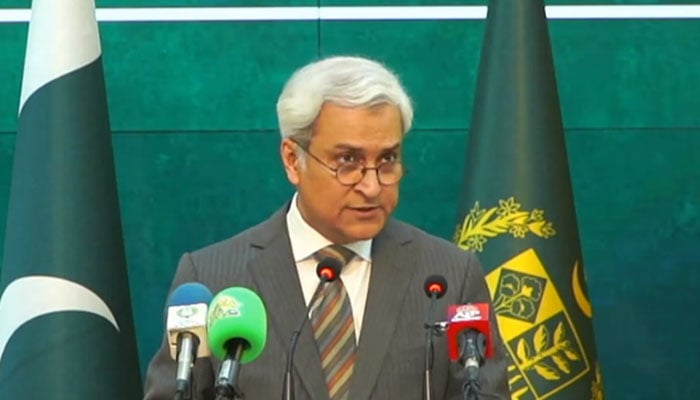
During the weekly press briefing, Foreign Office spokesperson Tahir Andrabi responded to questions about Afghan Interior Minister Sirajuddin Haqqani’s proposal for committees on both the Pakistani and Afghan sides to improve coordination and communication. Haqqani had said Afghanistan was prepared to act if Pakistan provided evidence, that preventing militants from operating from Afghan territory was Afghanistan’s responsibility, and that instructions had been issued at checkpoints to restrict militant movement. He had also suggested that Pakistan and Afghanistan should resolve their problems bilaterally without third-party mediation.
The spokesperson said Pakistan had taken note of the proposal for a dedicated bilateral mechanism to address contentious issues and remained open to state-level dialogue. However, he stressed that the sustainability of any mechanism would depend on tangible actions rather than assurances.
He said the Afghan Taliban must ensure that Afghan territory was not used for terrorism against Pakistan and must honor their international commitments, including those under the Doha framework. Kabul must also ensure that Afghan soil was not used by hostile proxies, particularly the TTP and BLA, against Pakistan.
Pakistan, he said, was ready for institutional coordination provided it produced tangible and verifiable counter-terrorism measures and effective border management.
Pakistan rejects claims about Kirana Hills
Responding to questions about former Indian Chief of Defence Staff General Anil Chauhan’s reported claim that an Indian drone could have wandered toward Pakistan’s strategic site at Kirana Hills near Sargodha during the May 2025 conflict, the spokesperson categorically rejected what he described as contradictory and retrospective Indian claims.
He said Pakistan’s layered air-defence network had effectively thwarted India’s military objectives, while Pakistan’s subsequent response under Operation Bunyan-ul-Marsoos had demonstrated its ability to impose costs across the conflict spectrum.
“No strategic asset or sensitive infrastructure was compromised in Pakistan,” he said, adding that attempts to retrospectively reinterpret the events through selective narratives or dramatized productions could not change the verifiable operational record of May 2025.
He said history was established through facts and evidence rather than what he termed “Bollywood-style retrospective claims.” Referring to the Indian claims made 16 or 17 months after the conflict, he described them as “post facto punches” that would be better directed at India itself.
Pakistan protests demolition of structures outside High Commission in Delhi
On India’s removal of structures outside Pakistan’s High Commission in New Delhi, the spokesperson said Indian authorities on August 19 had used heavy machinery to demolish sheds, benches and a walkway adjacent to the consular section of Pakistan’s High Commission.
He said the area was used by people seeking consular assistance and visas. Pakistan had lodged a strong protest and described the Indian action as a violation of the Vienna Convention on Diplomatic Relations, 1961.
He rejected any comparison between the incident and Islamabad’s ongoing anti-encroachment operation in the Diplomatic Enclave.
According to the spokesperson, Pakistan’s campaign was directed against unauthorized structures outside all diplomatic missions, not only India’s. He said the Foreign Office had previously held a briefing on the anti-encroachment drive attended by members of the diplomatic community, including the Indian High Commission, and the Indian side had been notified in advance to remove the structures.
He said India had failed to remove the facilities and subsequently initiated action in New Delhi against Pakistan’s High Commission without prior notice, making the two incidents incomparable.
Pakistan examining report about 150 Sindhi women in India
Asked about a Hindustan Times report concerning around 150 Sindhi women who reportedly travelled to India and married Indian nationals, the spokesperson said Pakistan was currently ascertaining the details.
He said no confirmed information was available with the Foreign Office at that time and promised to share details once they became available.
Pakistan says Hormuz opening remains a priority
A major portion of the briefing focused on the situation surrounding the Strait of Hormuz, the U.S.-Iran standoff and Pakistan’s ongoing mediation efforts.
The spokesperson rejected reports that the visit of the Chief of Defence Forces (CDF) to Iran had taken place as an envoy of U.S. President Donald Trump or at the request of Washington. He said such reports were misleading and factually incorrect.
According to him, the visit took place purely in the context of Pakistan’s ongoing role as a mediator in efforts to resolve the U.S.-Iran standoff.
He referred journalists to press releases and notes issued by the Foreign Office, the Inter-Services Public Relations (ISPR) and the Ministry of Information and Broadcasting regarding interactions between Pakistan’s leadership and important world leaders.
Regarding Pakistan’s trade with Iran amid U.S. pressure on countries dealing with Tehran, the spokesperson said Pakistan was acting in accordance with international law and its bilateral trade agreements with Iran, and its trade remained consistent with its international obligations.
Asked about the reported arrival of Qatar’s Prime Minister and Foreign Minister in Tehran and whether Pakistan and Qatar had become active again in mediation, Andrabi said Pakistan and brotherly countries were making concerted efforts for peace, dialogue and a settlement of the U.S.-Iran standoff.
He said Pakistan would welcome Qatar’s engagement on peace and dialogue and the implementation of the Pakistan-Qatar joint statement issued in Bürgenstock, which provided a roadmap for technical-level talks. He referred questions about the precise details of the Qatari leadership’s Tehran visit to Qatar’s Foreign Ministry spokesperson.
On U.S. economic measures against Iran, Pakistan said it hoped that economic issues would eventually be included in a wider settlement of the U.S.-Iran standoff because they were an important component of any viable long-term settlement. Pakistan, he said, remained engaged in its mediatory role.
Pakistan optimistic about reopening of Strait of Hormuz
Responding to questions about whether the Strait of Hormuz could reopen soon, particularly following the CDF’s interaction with Iranian officials and subsequent diplomatic contacts by Qatar and Oman, the spokesperson said renewed efforts had been made during the CDF’s visit to Tehran for reopening the strait.
He said Pakistan remained positive that momentum could develop toward reopening the vital waterway because its disruption was affecting everyone, particularly global energy supply chains.
He said the subsequent visits by Qatari and Omani officials reflected concerted efforts toward resolving the issue, especially the opening of the Strait of Hormuz.
Ultimately, however, the decision would rest with Tehran and Washington as sovereign parties, while interlocutors, mediators and facilitators could only make sincere efforts. He said such an effort had been made by Pakistan’s CDF during his Tehran visit.
Asked about reports that Iranian lawmakers had approved transit fees for ships passing through the Strait of Hormuz, the spokesperson declined to comment on the specific measure. He said the issue formed part of a broader discussion concerning the rights of littoral states to levy or collect fees and the obligations of countries whose ships pass through the strait.
Pakistan denies Afghan allegations of supporting unrest in Badakhshan
The spokesperson categorically rejected allegations by Afghan officials that Pakistan was behind unrest in Afghanistan’s Badakhshan province.
Journalists referred to comments by Taliban spokesperson Zabihullah Mujahid to DW accusing Pakistan of supporting the uprising in Badakhshan, as well as a statement by the Taliban security chief for Badakhshan alleging that Pakistan had established training camps for armed opponents of the Taliban.
Andrabi categorically denied the allegations.
He also clarified that Pakistan had not finalized any committee with Afghanistan, despite references to a proposed mechanism. He said his earlier response merely addressed the Afghan interior minister’s proposal and did not mean that Pakistan had agreed to establish such a committee.
Asked whether mediation by friendly countries had ended following reports that Pakistan had told Chinese Special Envoy Deng Xijun that it no longer wanted negotiations, the spokesperson said he was unaware of any such exchange.
He reiterated Pakistan’s existing position that Afghanistan must provide verifiable written assurances that its territory would not be used for terrorism against Pakistan. Until such assurances were provided, Pakistan’s position on its issues with Afghanistan would remain unchanged.
Pakistan says Afghan Taliban should act independently
Responding to remarks by Pakistan’s Permanent Representative to the United Nations Asim Iftikhar, who had described the Afghan Taliban government as a proxy, Andrabi said Pakistan hoped the Afghan Taliban would act independently and in accordance with their obligations under international law.
He said Afghan territory must not be used for terrorism in the region.
However, if Afghan authorities acted at the behest of another neighboring country to facilitate terrorism in Pakistan, including terrorism by Fitna al-Hind and Fitna al-Khawarij, Pakistan would unfortunately have to describe them as proxies because such actions would not represent Afghanistan’s own interests.
He said destabilizing Pakistan and killing Pakistanis could not be in the legitimate interests of the Afghan regime.
Pakistan, he added, had evidence of Indian involvement in terrorism inside Pakistan emanating from Afghan soil, and therefore the Afghan government must take action to end such terrorism.
Again stressing the difference between assurances and action, he said Pakistan expected verifiable measures against terrorist elements operating against Pakistan from Afghan territory.
Pakistan condemns Israeli settlement activity in West Bank
On Israeli claims that settlers in the West Bank had biblical rights to the territory, the spokesperson said Israeli settlement activity was contrary to and in violation of international law.
He said Israel had no right to construct settlements in the West Bank, adding that such settlements had been deemed illegal not only by the UN General Assembly but also by the UN Security Council through numerous resolutions.
Pakistan, he said, completely condemned the settlement activity and rejected any claim that Israel had a right to continue constructing settlements in the occupied West Bank.
Pakistan criticizes RSS anti-Muslim and anti-Pakistan activities
Asked about opposition in the United States to a planned visit by RSS chief Mohan Bhagwat, including calls for revocation of his visa over alleged persecution of minorities, the spokesperson said the RSS, its affiliates and cadres had been fomenting anti-Muslim hatred in India and stoking anti-Pakistan hatred.
He said Pakistan would not comment specifically on Bhagwat’s U.S. visit because it was primarily an issue for India and the United States.
However, he condemned violence against Muslims and what he described as hatred against Pakistan promoted through RSS platforms under state patronage.
He expressed hope that organizations and individuals in the United States concerned about such issues would raise them with the RSS leader if he visited the country.
Asked about a statement by the U.S. Commission on International Religious Freedom calling for sanctions against RSS members, including its chief, Andrabi said Pakistan was examining the report and would respond after reviewing it.
He also declined to add further comments regarding an RSS event reportedly planned at Madison Park in the United States on August 29.
Pakistan preparing for UN General Assembly session
Regarding Pakistan’s preparations for the upcoming UN General Assembly high-level week, the spokesperson said preparations were underway.
Details concerning the head of Pakistan’s delegation and other key engagements in New York would be shared in the coming days, including through a curtain-raiser.
He noted that Pakistan is currently a member of the UN Security Council and expected important meetings on peace and security to take place during the session.
He said France would hold the Security Council presidency next month and had already issued its programme of work, including several high-level meetings. Pakistan’s delegation would engage on important issues at the Council.
Pakistan would also participate in discussions concerning climate change and economic development and seek to mainstream its inputs into relevant outcome documents.
Pakistan says no details yet on possible Pakistan-India dialogue at SCO
Asked about the possibility of Prime Minister Shehbaz Sharif meeting Indian Prime Minister Narendra Modi on the sidelines of an SCO summit in Bishkek, alongside Chinese President Xi Jinping and Russian President Vladimir Putin, the spokesperson said Pakistan would share details as they emerged.
He said he currently had no information regarding the Prime Minister’s engagements in Bishkek and that further details would be provided in the coming days.
Pakistan clarifies Independence Day anniversary
The Foreign Office also clarified whether Pakistan celebrated its 79th or 80th Independence Day in 2026.
The spokesperson explained that if August 14, 1947, is counted as the first Independence Day, then 2026 represents the 80th Independence Day. However, if anniversaries are counted, the first anniversary occurred in 1948, making 2026 the 79th anniversary of independence.
He noted that this distinction explained why some institutions, including the Aiwan-e-Sadr, referred to it as the 79th anniversary while the Foreign Office referred to it as the 80th Independence Day.
Pakistan welcomes Syria’s removal from terrorism list
Pakistan welcomed the U.S. State Department’s decision to remove Syria from the list of state sponsors of terrorism.
The spokesperson said Pakistan believed it was important for Syria and its people to be mainstreamed into global affairs, particularly in the areas of economy, trade, culture and tourism.
He described Syria as an ancient civilization and a country with a deep history, noting that several revered Companions of the Holy Prophet (P.B.U.H.) were buried there.
Pakistan also welcomed the lifting of sanctions on Syria and said it looked forward to working with Damascus on bilateral issues and cooperating at multilateral platforms following the lifting of sanctions.
Pakistan confirms diplomatic relations with Somalia
On the detention of 10 Pakistani nationals by Somali pirates, the spokesperson clarified that Pakistan does have diplomatic relations with Somalia.
He said Pakistan was making every effort to secure the release of the nationals and that Deputy Prime Minister and Foreign Minister Ishaq Dar had discussed the matter with the Secretary-General of the International Maritime Organization (IMO) in London during the week.
Pakistan’s ambassador in Djibouti, who is concurrently accredited to Somalia, had also recently travelled to Mogadishu and met with the Somali leadership.
The spokesperson described the situation as extremely complex because the individuals were being held in territory with autonomous status within Somalia’s federal system. The ship was docked in that territory, while the cargo onboard included energy-related goods, creating additional challenges.
He said the local social structure was also complex and negotiations had to take place through different layers of the tribal society.
Pakistan had received assurances regarding the health of the 10 nationals. The Foreign Office hoped they remained safe and in good health and said it empathized with their families.
Pakistan, he added, was making every possible effort to end the hostage and kidnap-for-ransom crisis and ensure the safe repatriation of the Pakistani nationals.
Pakistan says no threat issued to UK over migrant returns
Asked whether Pakistan had threatened the United Kingdom with stopping the acceptance of deported illegal migrants if Britain attempted to force Pakistan to accept a grooming-gang ringleader in connection with the Rochdale issue, the spokesperson said he was unaware of any such exchange or threat.
He referred journalists to a substantive statement he had issued on the Rochdale issue about a month earlier.
MJDA remains open to new members
Asked whether Pakistan would support Iran or Bangladesh joining the Makkah Joint Defense Agreement (MJDA), the spokesperson reiterated that the defensive framework was aimed at safeguarding peace and promoting regional stability.
He said the MJDA remained open to countries sharing its commitments to collective obligations and common security interests.
Any formal request for membership, he said, would be considered in consultation with Pakistan’s partners in Riyadh and Ankara. However, the operationalization of the MJDA remained at an early stage, and he was not prepared to name potential new members.
National Security Adviser’s Bahrain and Kuwait visits
Asked about Pakistan’s National Security Adviser being seen in Bahrain and Kuwait, and whether the visits were linked to Pakistan’s mediation efforts, the spokesperson referred journalists to the National Security Division.
He said he understood that the visits might have had a bilateral context and that regional issues could also have been discussed, as such matters fell within the National Security Adviser’s mandate.
Pakistan monitoring floods in China and Nepal
Regarding severe flash floods and mudslides in China and Nepal, and whether Pakistan planned to send rescue and search teams or provide assistance through the National Disaster Management Authority (NDMA), the spokesperson said the Foreign Office was in contact with the governments concerned as well as the NDMA.
He said Pakistan would provide information when any relief or rescue flights were planned.
