
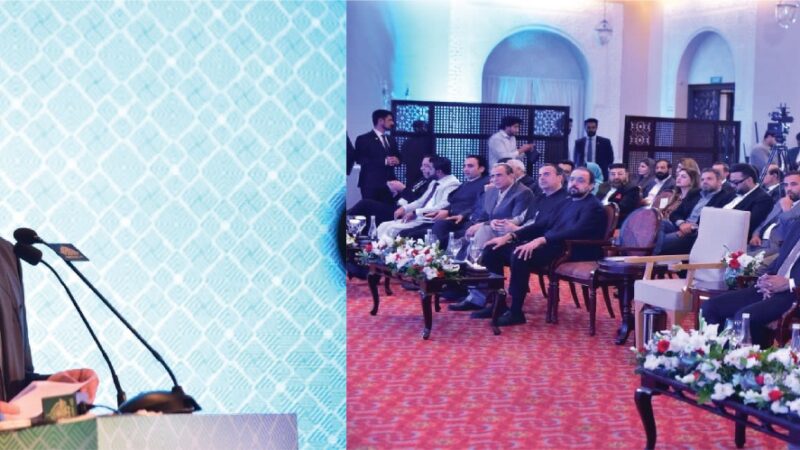


Islamabad — Pakistan’s Deputy Prime Minister and Foreign Minister addressed an extraordinary open-ended ministerial session of the Executive Committee of the Organization of Islamic Cooperation (OIC) on February 26 in Jeddah, strongly condemning what he described as Israel’s illegal measures to accelerate settlement expansion and annexation in the Occupied West Bank.
The high-level meeting, convened by the Republic of the Gambia as Chair of the Islamic Summit, the Republic of Türkiye as Chair of the OIC Council of Foreign Ministers, the Kingdom of Saudi Arabia, and the State of Palestine, focused on what participants termed the “grave and exceptional” situation in the Occupied Palestinian Territories.
In his remarks, the Foreign Minister warned that Israel’s actions — including the expansion of settlements, attempts at annexation, and alleged violations of the Gaza ceasefire — threaten not only the rights of the Palestinian people but also the credibility of international law and the multilateral system.
Referring to diplomatic engagements on the sidelines of the UN General Assembly in September 2025, he said leaders of eight Arab-Islamic countries, including Pakistan, had secured assurances from the United States that annexation of the West Bank would not take place. However, he maintained that developments on the ground contradict those assurances.
Pakistan strongly condemned what it called Israel’s recent steps to convert areas of the Occupied West Bank into so-called “state property,” describing the measures as reflective of an “annexationist and expansionist mindset.”
Call for Immediate International Action
As an elected member of the UN Security Council, Pakistan pledged to continue advocating for the Palestinian cause across UN bodies, the OIC, and other multilateral platforms. The Foreign Minister outlined several key demands:
Immediate reversal of all Israeli measures aimed at de facto annexation of the Occupied Palestinian Territory.
Full respect for the historic and legal status quo at holy sites, including Al-Aqsa Mosque.
An end to displacement, demographic changes, and collective punishment in the Occupied Palestinian Territory.
Full implementation of UN Security Council Resolution 2803 and adherence to the Gaza ceasefire.
Immediate commencement of Gaza’s reconstruction with a central role for the Palestinian Authority.
Accountability for alleged war crimes and violations of international humanitarian law.
A credible and time-bound political process leading to an independent Palestinian state based on pre-1967 borders, with Al-Quds Al-Sharif as its capital.
The Foreign Minister also highlighted Pakistan’s participation in the Board of Peace (BoP), established under UN Security Council Resolution 2803. Prime Minister Shehbaz Sharif attended the Board’s inaugural meeting in Washington, D.C., on February 19, reaffirming Islamabad’s commitment to a just resolution of the Palestinian issue.
Criticism of US Ambassador’s Remarks
During the session, Pakistan expressed strong condemnation of recent remarks by the United States Ambassador to Israel suggesting that Israeli control over certain territories belonging to Arab states could be acceptable. The Foreign Minister described the comments as irresponsible and inconsistent with international law and the UN Charter.
Pakistan said it had joined 14 Arab-Islamic countries, along with the OIC, the League of Arab States, and the Gulf Cooperation Council, in rejecting the statements.
Parallels with Kashmir
In his address, the Foreign Minister drew parallels between the situation in the Occupied Palestinian Territories and Indian Illegally Occupied Jammu and Kashmir. He alleged ongoing human rights violations and demographic changes in the disputed region and called on the OIC to intensify efforts toward a just resolution of the Jammu and Kashmir dispute.
“Defining Moment” for the Ummah
Concluding his speech, the Foreign Minister described the current crisis as a defining moment for the Muslim Ummah and urged unity and collective resolve among OIC member states. He reiterated Pakistan’s unwavering support for the Palestinian people’s right to self-determination and the establishment of an independent, viable, and contiguous State of Palestine.
The extraordinary OIC session underscored growing concern among Muslim-majority nations over escalating tensions in the region and the future of the two-state solution.
