
By Khawaja Nayyer
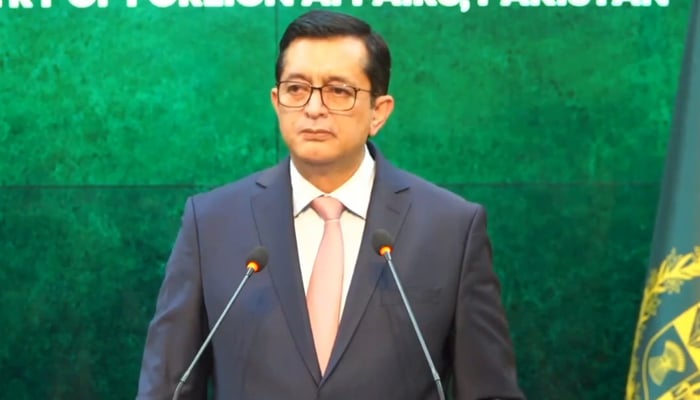
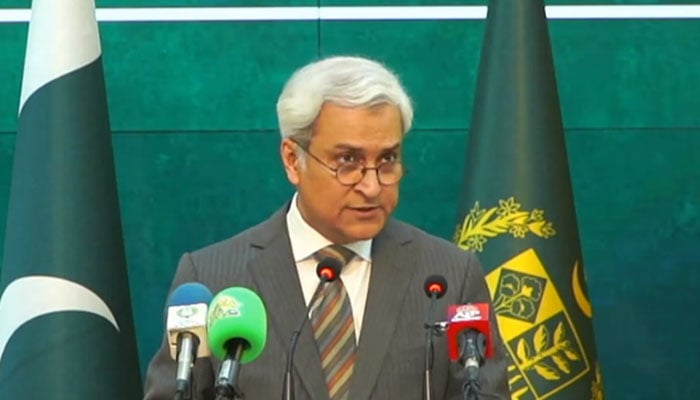
ISLAMABAD, Foreign Office Spokesperson Tahir Hussain Andrabi, in his final weekly media briefing before assuming his new diplomatic assignment as Pakistan’s Ambassador in Geneva, comprehensively addressed questions concerning India’s rejection of the Permanent Court of Arbitration (PCA) award on the Indus Waters Treaty, Pakistan-Afghanistan relations, the U.S.-Iran conflict, the Makkah Joint Defence Agreement, Kashmir, relations with China and the European Union, terrorism, Lebanon and other regional and diplomatic issues.
The spokesperson said India’s rejection of the PCA award raises concerns extending beyond the present water dispute, stressing that international law cannot be treated as a matter of convenience by invoking it when useful and discarding it when inconvenient.
He said India could neither disregard binding treaty obligations nor reject legal processes to which it had subscribed simply because their outcome was not to its liking. Such an approach, he maintained, undermines the sanctity of treaties, weakens confidence in international dispute-settlement mechanisms and creates adverse precedents for other regions where shared resources are governed through agreed legal frameworks.
Andrabi said unilateralism in the management of transboundary waters was particularly concerning in South Asia and urged India to return to full compliance with the Indus Waters Treaty, respect its institutional and dispute-settlement mechanisms and engage Pakistan constructively within the framework accepted by both sides.
He categorically maintained that India’s rejection of the award could not extinguish or alter its obligations under the treaty or its responsibility to implement the Court of Arbitration’s decision. Pakistan, he said, would take all possible measures to ensure implementation of the award. The spokesperson added that all diplomatic and non-diplomatic options remain on the table concerning the decision and the broader issue of India’s alleged weaponization of water.
He clarified that India’s participation was necessarily part of the treaty-based dispute-resolution process because it is a signatory to the Indus Waters Treaty, and therefore New Delhi could not absolve itself of responsibility for the outcome.
The PCA ruling has reaffirmed the continuing validity and binding nature of the Indus Waters Treaty, while India has rejected the tribunal’s authority and said the ruling would not affect its decisions concerning hydroelectric projects.
On the possibility of renegotiating the Indus Waters Treaty, Andrabi said Pakistan remained committed to the agreement “in letter and spirit” and expected India to adopt the same approach. He said he was not specifically aware of any team of experts or exchange of visits under the treaty but would check with the relevant authorities.
Pakistan-Afghanistan relations
Turning to Afghanistan, the spokesperson said Pakistan appreciated China’s constructive and sustained engagement on the issue. Chinese Special Representative for Afghanistan Ambassador Yue Xiaoyong visited Islamabad from August 31 to September 1 and held detailed discussions with Special Assistant to the Prime Minister Ambassador Muhammad Sadiq.
Pakistan, Andrabi said, had always remained positively engaged for constructive dialogue on Afghanistan. However, he made clear that progress in Pakistan-Afghanistan relations depends on the Taliban regime providing concrete, written and verifiable assurances that Afghan territory will not be used for terrorism against Pakistan.
He specifically referred to the TTP, BLA and other terrorist organizations operating from Afghan soil and said meaningful progress would depend upon concrete and verifiable action by Kabul.
The spokesperson said there had been no new assurances from Kabul since his previous briefing and therefore he had nothing further to add regarding the possibility of direct talks.
Regarding Afghan Ambassador Sardar Ahmad Shakeeb’s appearance at the National Defence University, Andrabi described it as an academic engagement, saying diplomats routinely visit academic institutions and such interactions should not be treated as an indicator of the state of bilateral relations. He said Pakistan’s policy towards Afghanistan remained unchanged.
Pakistan continues efforts to de-escalate U.S.-Iran conflict
On the escalating U.S.-Iran confrontation, Andrabi said Pakistan remained concerned about the armed attacks, counterattacks and retaliatory actions but was not discouraged from pursuing diplomacy.
He rejected the suggestion that the escalation represented a failure of Pakistan’s mediation efforts, saying international conflicts often pass through cycles of escalation, relative calm, cessation of hostilities and eventual return to negotiations.
Pakistan, he said, remained engaged “in complete earnest” with the peace process. Prime Minister Shehbaz Sharif had met Iranian President Masoud Pezeshkian in Bishkek, while Deputy Prime Minister and Foreign Minister Ishaq Dar had met Iranian Foreign Minister Abbas Araghchi. The Chief of Defence Forces had also visited Tehran, generating momentum particularly concerning the standoff in the Strait of Hormuz.
Andrabi said the Islamabad MoU and Pakistan-Qatar Joint Statement provide a framework for the parties to return to negotiations, including technical-level dialogue, with the objective of achieving a sustainable settlement.
Pakistan’s position is that the latest escalation should not derail diplomatic efforts; the Foreign Office has described the renewed fighting as concerning and undesirable while maintaining that dialogue remains the viable route to peace.
Asked about U.S. President Donald Trump’s dismissal of the value of an agreement with Iran, Andrabi said strong statements were common during periods of escalation. He said the Islamabad MoU remained a framework for peace and that Pakistan remained hopeful the parties would eventually return to negotiations.
Pakistan monitoring impact of U.S. measures on Iran trade
Regarding the latest U.S. economic measures and sanctions, Andrabi said Pakistan had taken note of them and believed the prevailing circumstances required restraint, dialogue and sustained diplomatic engagement.
He said the potential impact of the measures on Pakistan-Iran trade was being carefully evaluated and monitored in coordination with the Ministry of Commerce.
Makkah Joint Defence Agreement
A significant portion of the briefing focused on the Makkah Joint Defence Agreement involving Pakistan, Saudi Arabia and Türkiye.
Andrabi said the agreement should be understood through the substance of the communiqué and joint statement rather than speculative interpretations or variations in terminology.
He explained that references to the agreement could differ because discussions were taking place in Arabic, Turkish, English and Urdu. He said there had been no formal announcement of a change in its name and that any formal change would be communicated officially.
Regarding the possible participation of other countries, the spokesperson said certain countries had been mentioned publicly but he was not aware of any formal applications or a confirmed list. Any request to join would be examined in consultation with Pakistan’s partners in Riyadh and Ankara, particularly regarding collective obligations and common security interests.
He also declined to speculate about whether non-Muslim countries, including the United States, could participate or provide defence cover, saying the official joint statement already provided the necessary framework.
Pakistan, he said, views the agreement as a defence framework serving the interests of the three participating countries as well as wider regional interests, with the objective of promoting peace, prosperity and regional stability and reducing the prospects of war.
The operationalization of the agreement remains at an early stage, he said, adding that the first committee meeting in Istanbul had generated progress and consultations would continue.
Pakistan will also nominate the Secretary-General of the mechanism. Andrabi said the appointment would be announced in due course and that an individual befitting the importance of the responsibility would be selected. He did not specify whether the nominee would be a diplomat or military officer.
Pakistan rejects trial and sentencing of Yasin Malik
On Kashmiri leader Yasin Malik, the spokesperson reiterated Pakistan’s categorical rejection of his trial, persecution and sentencing, describing the proceedings as a “sham trial” in which the principles of justice had been undermined.
Pakistan, he said, would continue raising Malik’s case at relevant international platforms and hoped for his long life and good health.
No change in Pakistan’s Kashmir policy
Andrabi categorically rejected any suggestion that Pakistan had changed its position on Jammu and Kashmir.
He said Pakistan’s position remains anchored in UN Security Council resolutions, international law and the wishes of the people of Jammu and Kashmir.
He explained that the absence of an extensive reference to Kashmir in the weekly opening statement did not indicate any policy change, as the statement generally focuses on developments during the preceding week.
The spokesperson said Kashmir had been raised during Pakistan’s leadership-level interactions in Bishkek, including discussions involving the UN Secretary-General. He added that UN Secretary-General António Guterres had been invited to visit Pakistan and that dates would be finalized through mutual consultation.
Regarding the death anniversary of Syed Ali Shah Geelani, Andrabi said events had been held in Islamabad and elsewhere by civil society, academia and think tanks, with the Foreign Office also participating in some of them. He said Geelani’s contribution to the Kashmir cause and the right to self-determination would remain in Pakistan’s memory.
Pakistan-EU engagement and GSP+ review
The Foreign Office also addressed the European Union’s latest GSP+ monitoring report.
Andrabi said the European Commission had published its biannual GSP monitoring report for 2023–2025, describing it as the final monitoring report under the current GSP+ framework concerning Pakistan’s compliance with 27 international conventions.
Pakistan, he said, appreciated the Commission’s recognition of the country’s continued compliance with the conventions but believed that the report’s overall narrative did not present a sufficiently balanced picture of Pakistan’s performance.
He reaffirmed that GSP+ remains central to Pakistan’s economic relationship with the European Union and said Islamabad would continue constructive engagement with the EU and remain committed to effective implementation of the international conventions underpinning the framework.
Pakistan supports Lebanon’s sovereignty
Regarding the visit of the Syrian foreign minister to Pakistan, Andrabi said the visit was primarily bilateral and should not be directly linked to Pakistan’s wider regional diplomatic efforts.
However, he acknowledged that Syria, as a neighbour of Lebanon, is an important stakeholder in matters concerning Lebanon. He said it was therefore logical if Lebanon had been discussed during the visit.
Pakistan, he stressed, supports Lebanon’s sovereignty and territorial integrity and rejects incursions and violations of Lebanese sovereignty by Israel.
He said Pakistan remains engaged with Lebanon through bilateral channels as well as the United Nations and other multilateral forums.
Pakistan highlights external dimension of terrorism
Responding to criticism that Pakistan was seeking a wider security role through the Makkah agreement while facing militant violence domestically, Andrabi rejected the characterization that Islamabad was assuming the role of “global guardians.”
He distinguished between the internal and external dimensions of terrorism.
Domestic security and counterterrorism operations, he said, fall outside the Foreign Office’s mandate and should be addressed by the relevant authorities. He referred to recent counterterrorism operations and ISPR statements.
However, the external dimension falls within the Foreign Office’s mandate. Andrabi reiterated Pakistan’s allegations concerning support and abetment for terrorist groups from elements in Afghanistan, including the Taliban regime, as well as what Pakistan says is support from India.
He said Pakistan had provided concrete evidence regarding the external dimension of the terrorism threat and would continue raising the matter internationally. Prime Minister Shehbaz Sharif had also highlighted terrorism during his engagements at the SCO.
Pakistan-China ties unaffected by China-India relations
On reports of growing China-India engagement, including a possible visit by Chinese President Xi Jinping to India, Andrabi said Pakistan views relations between other countries within their own bilateral context.
Pakistan welcomes engagement that contributes to regional peace and stability, he said, while emphasizing that Islamabad’s close, all-weather strategic partnership with China is not affected by either country’s relationship with a third party.
Pakistan to fulfil SCO chair responsibilities
On Pakistan’s assumption of the SCO chairmanship, Andrabi said Islamabad would fulfil its responsibilities in accordance with the SCO Charter and relevant rules of procedure.
He said Pakistan had followed the same approach when it chaired the SCO Council of Heads of Government and hosted the meeting in 2024.
He also attributed Pakistan’s recent diplomatic achievements to the country’s leadership and state institutions, rather than to his own tenure as spokesperson, crediting Prime Minister Shehbaz Sharif, Deputy Prime Minister and Foreign Minister Ishaq Dar, other state institutions and the armed forces for the collective diplomatic effort.
UK issue involving Imran Khan’s sons
Asked whether Pakistan had raised diplomatically with Britain the broadcasting of an interview with Imran Khan’s sons on Sky Television, Andrabi said he was not aware of any bilateral exchange on the matter.
He said the issue was outside the mandate of the Ministry of Foreign Affairs.
President Zardari’s London engagements
On President Asif Ali Zardari’s ongoing European visit and meetings in London involving senior Pakistani officials, including Interior Minister Mohsin Naqvi, the spokesperson declined to comment.
He respectfully referred journalists to the Office of the President for information concerning the president’s official engagements.
The briefing also marked Tahir Hussain Andrabi’s final weekly media briefing as Foreign Office spokesperson before his departure for his new diplomatic assignment as Pakistan’s Ambassador in Geneva.
During the briefing, journalists expressed good wishes and appreciation for his cooperation and representation of Pakistan’s foreign policy position. Andrabi thanked the media for its kind words and said he had been fortunate and humbled to serve as spokesperson during a period of significant diplomatic activity.
