
By Khawaja Nayyer
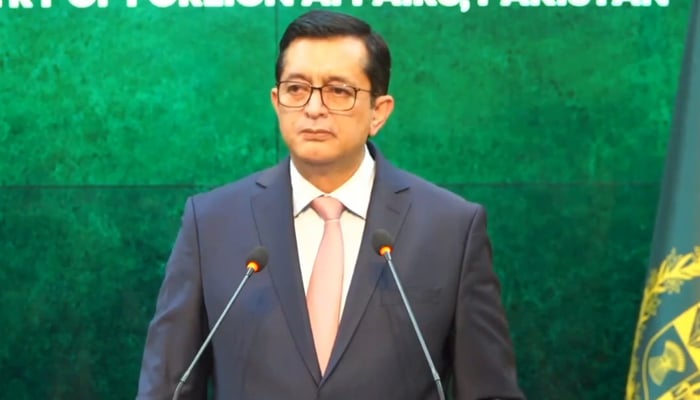
ISLAMABAD,Foreign Office Spokesperson Sajjad Haider on Friday reiterated Pakistan’s support for the internationally recognised disputed status of Jammu and Kashmir, reaffirmed its commitment to Palestinian self-determination, and defended Pakistan’s participation in the Makkah Defence Alliance, describing it as a defensive arrangement aimed at protecting the sovereignty and territorial integrity of its member countries.
Addressing the weekly media briefing of the Ministry of Foreign Affairs, Sajjad Haider responded to questions on the visit of the United Nations Secretary-General, the Kashmir dispute, the situation in Gaza, escalating tensions involving Saudi Arabia and Yemen, Pakistan-Afghanistan relations, the Makkah Defence Alliance, US-Iran mediation, climate change, poverty, overseas Pakistanis and other regional and international developments.
Pakistan Welcomes UN Secretary-General’s Remarks on Kashmir
Sajjad Haider said Pakistan welcomed the United Nations Secretary-General’s acknowledgement of the important role played by the United Nations Military Observer Group in India and Pakistan (UNMOGIP) in maintaining regional peace and stability.
He described Jammu and Kashmir as one of the oldest unresolved internationally recognised disputes on the agenda of the UN Security Council. He said the relevant UN resolutions stipulate that the final disposition of the dispute must reflect the will of the Kashmiri people through a free and impartial plebiscite under UN auspices.
The spokesperson described UNMOGIP as a symbol of the United Nations’ continued commitment to the people of Jammu and Kashmir and the wider region. He called for strengthening the mission’s presence and role alongside a just settlement of the dispute in accordance with relevant UN Security Council resolutions and the aspirations of the Kashmiri people.
Responding to India’s reported issuance of a new political map dated October 2, 2026, depicting parts of the disputed region as falling within Indian territorial jurisdiction and incorporating standardised or renamed places, Haider categorically rejected the move as an act of cartographic aggression.
He said unilateral cartographic exercises were legally void and could not alter Jammu and Kashmir’s internationally recognised disputed status or confer legitimacy on India’s control over the territory.
The spokesperson urged India to comply with international law and relevant UN Security Council resolutions and allow the Kashmiri people to exercise their right to self-determination through a free and impartial plebiscite under United Nations auspices.
Haider also rejected the impression that the UN Secretary-General had ignored the Kashmir dispute during his visit to Pakistan, saying his visit to UNMOGIP reflected the importance attached to the mission and the need for a peaceful settlement of regional disputes.
He said the Secretary-General had expressed appreciation for Pakistan’s hospitality, resilience and contribution to accommodating more than four million Afghan refugees over several decades. The spokesperson also recalled the Secretary-General’s previous visits to Pakistan and his appreciation of the country’s response to the devastating 2022 floods.
Pakistan Reaffirms Support for Palestinian Statehood
The Foreign Office spokesperson said Pakistan’s position on Palestine remained unchanged despite questions about a recent Board of Peace statement focusing on Israel’s security, the demilitarisation of Gaza and the threat posed by Hamas without explicitly addressing Palestinian statehood or the broader issue of occupation.
Haider said Pakistan had joined the Board of Peace alongside other Arab and Islamic countries to help end bloodshed in Gaza and advance a credible political process consistent with international law and relevant United Nations resolutions.
He called for the full implementation of the Gaza Peace Plan and UN Security Council Resolution 2803, the protection of Palestinian civilians, an end to settlement activity and forced displacement, and the realisation of the Palestinian people’s right to self-determination.
Pakistan, he said, remained committed to an independent, sovereign and contiguous State of Palestine based on the pre-1967 borders, with Al-Quds Al-Sharif as its capital.
Pakistan Defends Makkah Defence Alliance Amid Regional Escalation
Addressing concerns over escalating regional tensions and reported attacks on Saudi Arabia, Haider said the joint statement issued by the participating countries clearly reflected their shared commitment to deterrence and the protection of the Kingdom’s sovereignty and territorial integrity.
He said Pakistan already had a substantial number of troops and resources in Saudi Arabia and that the alliance’s leadership would assess the threat environment and determine operational requirements according to its mandate.
The spokesperson declined to disclose further operational details, saying decisions regarding the scale, timing and location of deployments were matters for the alliance’s headquarters and relevant authorities.
He recalled that Pakistan’s armed forces had maintained a presence in Saudi Arabia in various capacities since 1982, including logistical arrangements and training missions. He added that further deployments had taken place following the signing of the Strategic Mutual Defence Agreement between Pakistan and Saudi Arabia last year.
At a recent meeting of the Strategic Political Defence Committee, representatives of the three participating countries agreed that appropriate resources would be mobilised according to requirements.
Haider said the Makkah Defence Alliance was a defensive organisation intended to strengthen deterrence, consolidate military capabilities and protect member countries against aggression.
He categorically rejected the suggestion that the alliance was intended to launch cross-border attacks against Houthi forces in Yemen, stressing that the participating forces would be used to defend Saudi territory and safeguard its sovereignty.
Pakistan Rejects Reports of Fighter Jets Operating in Yemen
The spokesperson dismissed reports that Pakistani fighter jets had participated in airstrikes against Houthi targets in Yemen, describing them as speculative and false. He added that the reports had also been refuted by the Minister for Information.
Responding to questions about whether countries other than Israel could be involved in attacks on Saudi Arabia, Haider said it would be speculative to name any country without specific information.
He acknowledged that militia groups had been involved in proxy activities and contributed to regional instability but declined to identify any additional actors allegedly involved in the attacks.
Government Fully Involved in Defence Decisions
Haider rejected the impression that Pakistan’s participation in the Makkah Defence Alliance was a unilateral decision taken without consultation with the civilian government.
He described the arrangement as a whole-of-government approach, pointing to meetings chaired by the Prime Minister and subsequent deliberations of the Strategic Political Defence Committee, headed by the Deputy Prime Minister and Foreign Minister and attended by the Defence Minister.
He noted that both ministers were members of Parliament and the Cabinet, adding that the government was fully on board with the arrangement.
The spokesperson said Pakistan would follow its own rules of business and applicable legal procedures in decisions concerning military deployments. He maintained that the existing agreement and deployment were covered by the relevant legal and administrative framework, while any future requirement to take the matter to Parliament would be considered separately.
Rejecting concerns that Pakistan was entering a new conflict despite its security challenges along the eastern border, Haider said tensions with India were not new and had existed since Pakistan’s independence in 1947.
He said Pakistan remained prepared to defend its sovereignty and territorial integrity and expressed confidence in the country’s ability to protect itself against external threats.
Attacks on Saudi Arabia a Major Concern for Pakistan
The spokesperson said the deteriorating security situation in Saudi Arabia was a matter of serious concern for Pakistan because approximately 2.5 million Pakistanis lived in the Kingdom.
He warned that further escalation could place Pakistani nationals at risk and referred to the reported death of a Pakistani truck driver in a drone attack in Yemen.
Haider said Pakistan would continue to advocate de-escalation, dialogue and diplomacy while remaining committed to protecting Saudi Arabia’s sovereignty and supporting the welfare of Pakistani citizens living there.
He added that the situation remained under control but stressed that the potential consequences of further escalation could be significant.
The temporary suspension of Pakistan International Airlines flights to Riyadh was also discussed in the context of the worsening regional security environment.
Türkiye’s Role in the Alliance
Responding to questions about Türkiye’s position on troop deployments, Haider said he would not comment on another country’s specific military requirements.
He noted that Türkiye had signed the Makkah Alliance agreement and committed itself to providing necessary support to strengthen the organisation’s defensive capabilities.
The spokesperson said the presence of Türkiye’s Foreign Minister, Chief of Defence Forces and Defence Minister at the October 5 meeting in Riyadh reflected Türkiye’s engagement with the alliance. He added that operational requirements would be fulfilled in due course, according to each participating country’s procedures.
## Pakistan Says Moscow Format Differences Do Not Undermine Regional Dialogue
Haider said Pakistan had participated constructively in the recent Moscow Format meeting on Afghanistan and had clearly conveyed its concerns regarding terrorism emanating from Afghan territory.
He explained that the meeting ended without a joint statement because the Afghan Taliban delegation objected to retaining language on terrorism that had been agreed upon during the previous year’s meeting.
Pakistan maintained that terrorism emanating from Afghanistan posed a serious threat to neighbouring countries, particularly Pakistan, and that the issue was a substantive security concern rather than merely a disagreement over wording.
The spokesperson said a joint statement that failed to adequately reflect these concerns would not present a fair picture of the ground realities. However, he stressed that the absence of a joint statement should not overshadow the importance of regional dialogue.
Pakistan had not yet made a final decision about participating in the next Moscow Format meeting, which was approximately a year away. Haider said sufficient time remained for consultations before a decision was taken.
He also referred to remarks by the Russian representative, who had reportedly expressed surprise that the Taliban objected to language on preventing terrorism in Afghanistan that had been accepted the previous year.
According to Haider, the Afghan Taliban had argued that the ground situation had changed. Pakistan’s assessment, however, was that terrorist attacks originating from Afghan territory had intensified and that militant groups had gained greater operational space.
He called for neighbouring countries and the international community to work together to address the threat.
Pakistan Rejects Afghanistan’s Allegations Over ISKP and Airstrikes
The Foreign Office categorically rejected allegations by Afghanistan’s Foreign Minister that Pakistan supported the Islamic State Khorasan Province (ISKP) or was conducting activities in Afghanistan’s Nuristan and Badakhshan provinces.
Haider instead accused the Tehreek-e-Taliban Pakistan (TTP), the Balochistan Liberation Army (BLA) and other terrorist organisations of finding safe havens in Kabul and elsewhere in Afghanistan.
He said Pakistan had conveyed information about the precise locations of suspected militants to the Afghan authorities through political and security channels.
According to the spokesperson, Pakistan’s military strikes had targeted specific locations where militants were allegedly planning or facilitating attacks against Pakistan.
He rejected Afghan allegations concerning the presence of terrorists at the targeted locations and claims that children and elderly people had been killed in the strikes, maintaining that the accusations against Pakistan were unfounded.
Haider urged the Afghan government to take responsibility for preventing militant groups from using Afghan territory to plan and facilitate attacks against Pakistan.
He said Islamabad remained willing to establish friendly and constructive relations with Kabul if the Afghan authorities addressed Pakistan’s security concerns and stopped facilitating militant activity.
The spokesperson also reiterated Pakistan’s categorical rejection of reports that Pakistani fighter jets had taken part in operations in Yemen.
Pakistan Continues Mediation Between the United States and Iran
Haider said Pakistan’s diplomatic engagement between the United States and Iran remained relevant despite the escalation of regional tensions and Islamabad’s defence cooperation with Saudi Arabia.
He noted that the two countries were engaged in discussions and had exchanged seven points, while reports indicated that the US government had also shared its position on those proposals.
The spokesperson described the direct communication between Washington and Tehran as an outcome of Pakistan’s mediation efforts.
He said the Islamabad memorandum of understanding remained in place and that some of the points under discussion were consistent with its provisions.
Pakistan wanted both countries to cooperate directly, de-escalate tensions and reach a negotiated settlement. Haider said Islamabad would be willing to play its mediating role again if required.
He emphasised that Pakistan supported diplomacy and political dialogue as the preferred means of resolving disputes and preventing further conflict.
Pakistan Says Dialogue With Houthis Depends on Conditions
Responding to a question about Iran’s reported request for Pakistan to engage politically with the Houthi movement, Haider reiterated Islamabad’s support for diplomacy and de-escalation.
However, he questioned whether negotiations would be productive under the prevailing circumstances, accusing the Houthis of seeking greater influence through disruptions to maritime communication routes and attacks on infrastructure, including sites in Saudi Arabia.
The spokesperson said meaningful diplomacy depended on the willingness of all parties to pursue peace. He maintained that the parties needed to address the prevailing situation before further negotiations could produce tangible results.
Pakistan did not announce a specific new diplomatic initiative involving the Houthis.
Pakistan Highlights Role in Regional Peace and Stability
The spokesperson said visiting dignitaries had appreciated Pakistan’s efforts to reduce tensions and promote stability in West Asia.
He referred to the involvement of Pakistan’s political and military leadership, including the Prime Minister, President, Foreign Minister, Army Chief and Interior Ministry, in diplomatic efforts aimed at preventing further escalation.
Haider said Pakistan’s objectives included promoting regional peace, keeping maritime communication routes open and facilitating the resumption of supply chains.
He added that the United Nations Secretary-General and Bahrain’s Foreign Minister had also appreciated Pakistan’s role in promoting stability.
Pakistan and the Holy See Discuss Bilateral Relations
Haider said the recent visit by a senior representative of the Holy See provided an opportunity to strengthen relations between Pakistan and the Vatican.
The visiting Archbishop, described as the first Secretary for Relations with States and International Organisations of the Holy See to visit Pakistan, held a useful meeting with the Deputy Prime Minister.
Discussions covered bilateral relations, interfaith harmony and the welfare of Pakistan’s Christian community.
The visiting dignitary was also scheduled to meet members of the Christian community and participate in religious ceremonies.
The spokesperson said both sides had considerable interest in expanding cooperation and improving the situation of Pakistan’s Christian minority.
He did not provide further details about whether the Archbishop had expressed a specific position on the conflict involving Iran, Israel and the United States.
Pakistan Says Trade With Iran Must Comply With Sanctions
Responding to a question about trade with Iran, Haider said he did not have complete information about the current situation on the ground.
He emphasised that not all trade activities were necessarily subject to sanctions and said Pakistan would continue to comply with applicable international regimes and sanctions.
The spokesperson did not confirm any specific illegal trade activity involving Iran.
Pakistan Criticises Restrictions on Pakistani Social Media Accounts in India
Haider criticised India’s reported blocking of a Pakistani journalist’s social media account after he shared material concerning the appearance of retired Havaldar Muhammad Asif at a Pakistani military media event.
The spokesperson said the incident raised concerns about freedom of speech and expression. He also alleged that thousands of Pakistani websites and social media accounts had been blocked in India and that Pakistani television channels were banned.
He referred to Pakistani cultural figures, including singer Rahat Fateh Ali Khan, whose websites or social media content he said had also faced restrictions.
The spokesperson expressed understanding of the journalist’s frustration and criticised what he described as restrictions on diverse viewpoints.
Pakistan Says Climate Change Requires Long-Term Action
The Foreign Office acknowledged that climate change posed a major challenge for Pakistan, particularly because of melting glaciers, glacial lake outburst floods (GLOFs) and the risk of downstream flooding in northern areas.
Haider said Pakistan was among the countries most vulnerable to climate-related disasters despite contributing a relatively small share of global carbon emissions.
He said the government was pursuing climate adaptation measures, public awareness initiatives, tree planting and other steps to prepare communities for environmental challenges.
Responding to warnings about a possible severe Super El Niño event, the spokesperson said the government was aware of the wider climate threat but did not provide a detailed list of preventive measures specifically linked to the forecast.
He described climate adaptation as a long-term process requiring sustained government action.
Foreign Office Seeks Further Review of Poverty Report
Responding to a question about a reported World Bank assessment suggesting that 48 per cent of Pakistan’s population lived below the poverty line, Haider said he could not confirm the figure because he had not reviewed the report.
He said the document would need to be examined before the government could provide a definitive response.
The spokesperson referred to poverty figures in India but did not offer an alternative estimate for Pakistan or identify the methodology behind the reported figure. The matter therefore remained subject to further clarification.
Pakistan Addresses Concerns Over Overseas Pakistanis
Haider responded to reports that Pakistani diplomatic missions had prepared lists of overseas Pakistanis who protested outside Pakistani embassies and consulates and forwarded the names to authorities in Pakistan.
He said individuals involved in violence or acts of terrorism against government institutions, state infrastructure, police or military personnel had been identified. He referred specifically to individuals associated with the Joint Awami Action Committee (JAAC).
However, the spokesperson stressed that people who had not engaged in such activities were entitled to freedom of expression and could express their grievances through different means.
He also said the situation in Azad Jammu and Kashmir had returned to normal following recent elections and the formation of a new government.
The briefing did not confirm whether lists of peaceful protesters had been circulated to authorities or whether overseas travellers had been stopped or arrested solely because of peaceful demonstrations.
Pakistan Responds to Questions About British Debate on Kashmir
Addressing a question about a British member of Parliament who had raised issues in Azad Jammu and Kashmir while allegedly overlooking human rights concerns in Indian Illegally Occupied Jammu and Kashmir, Haider said Kashmir remained an important subject of international discussion.
He referred to commemorations held by Kashmiri and Pakistani communities on February 5, August 5 and October 27, describing these dates as important occasions for highlighting the dispute.
The spokesperson said the Kashmiri and Pakistani diasporas had played a prominent role in presenting Pakistan’s position and drawing international attention to the legal and political dimensions of the Kashmir dispute.
He suggested that some parliamentary discussions could also arise from the requirements of local constituencies.
