




By Khawaja Hamza
MAKKAH, Pakistan, Saudi Arabia and Türkiye have signed a landmark Joint Defence Agreement aimed at strengthening collective security, deterrence and defence cooperation among the three countries, with the pact declaring that an armed attack against any one of the three states will be considered an attack against all.
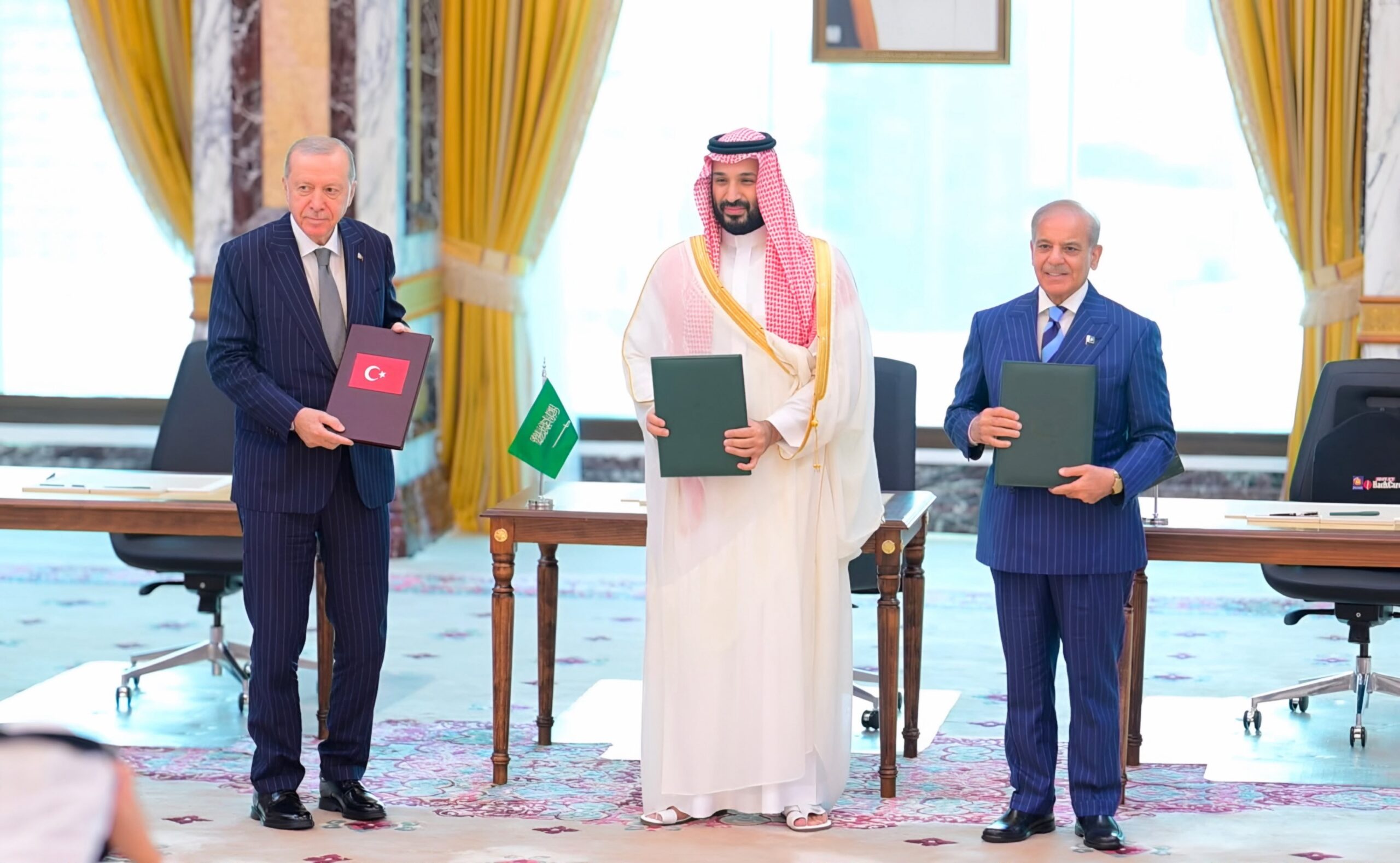
The agreement was signed during the Makkah Summit for Joint Defence held at Qasr Al-Safa in Makkah. Saudi Crown Prince and Prime Minister Mohammed bin Salman bin Abdulaziz Al Saud received Turkish President Recep Tayyip Erdoğan and Pakistani Prime Minister Muhammad Shehbaz Sharif at the summit, held on August 7, 2026, corresponding to 24 Safar 1448 AH.
The summit reviewed the longstanding relations among Saudi Arabia, Türkiye and Pakistan and discussed a range of issues of mutual interest. In view of their historic ties, bonds of brotherhood and Islamic solidarity, shared strategic interests and long-standing defence cooperation, the three leaders signed the Makkah Joint Defence Agreement.
According to the joint declaration, the agreement reflects the three countries’ shared commitment to further strengthening their collective security and promoting peace, security and stability in the region and around the world, with the objective of ensuring a secure and prosperous future.
The agreement specifically aims to strengthen collective defence against aggression. It establishes that any armed attack against one of the three countries will be considered an attack against all three countries, creating a formal collective-defence commitment.
The pact also provides for the expansion and strengthening of defence cooperation across all fields between Pakistan, Saudi Arabia and Türkiye.
The trilateral framework comes against the backdrop of a rapidly changing regional strategic environment marked by conflicts, evolving security threats and the changing character of warfare. The three countries view enhanced cooperation as necessary to address common security challenges, preserve regional stability and strengthen collective deterrence.
The agreement is being described as defensive rather than offensive and is not directed against any particular country. Its stated purpose is to prevent conflict through credible deterrence, strengthen defensive capabilities and contribute to peace and stability.
The partnership combines three complementary strategic strengths. Pakistan contributes its military strength, battle-hardened armed forces and strategic expertise, including experience in managing escalation and complex security challenges. Saudi Arabia brings its central strategic position in the region, strong economy and significant regional influence, while Türkiye contributes advanced defence technology, military resilience and a powerful indigenous defence-industrial base.
Through closer military capabilities, intelligence cooperation and strategic coordination, the three countries seek to increase the cost of aggression while reducing the likelihood of conflict through credible collective defence.
The framework also marks a further institutionalisation of decades of strategic relations. Pakistan’s ties with Türkiye have historical roots predating Pakistan’s independence, including the Khilafat Movement of 1919–1924, while Islamabad and Riyadh have maintained longstanding strategic, political, economic and people-to-people relations based on mutual trust and shared interests.
The trilateral arrangement is being positioned as neither a religiously based military convergence nor a “Muslim NATO,” and does not constitute nuclear backstopping. Rather, it represents a defensive and non-aggressive security partnership focused on collective security, collective deterrence, strategic self-reliance and people-centred prosperity.
Pakistan’s role in the emerging framework also reflects its broader regional diplomatic positioning. Islamabad’s constructive relations with Saudi Arabia, Türkiye, Iran, the United States, China and other regional and international stakeholders provide it with an opportunity to contribute to regional stability and act as a bridge between different stakeholders.
The credibility of the new framework will depend on the sincerity, clarity and competence of the leadership of all three countries, particularly their ability to combine military preparedness with strategic restraint and diplomacy while safeguarding national security interests.
The agreement therefore represents a significant step in the evolution of Pakistan–Saudi Arabia–Türkiye strategic relations, formally codifying existing defence cooperation while establishing a stronger mechanism for collective defence and deterrence.
The three countries said the ultimate objective of the agreement is to strengthen their collective security, deter aggression and contribute to peace, stability, security and prosperity in the region and beyond.
