
By Khawaja Hamza
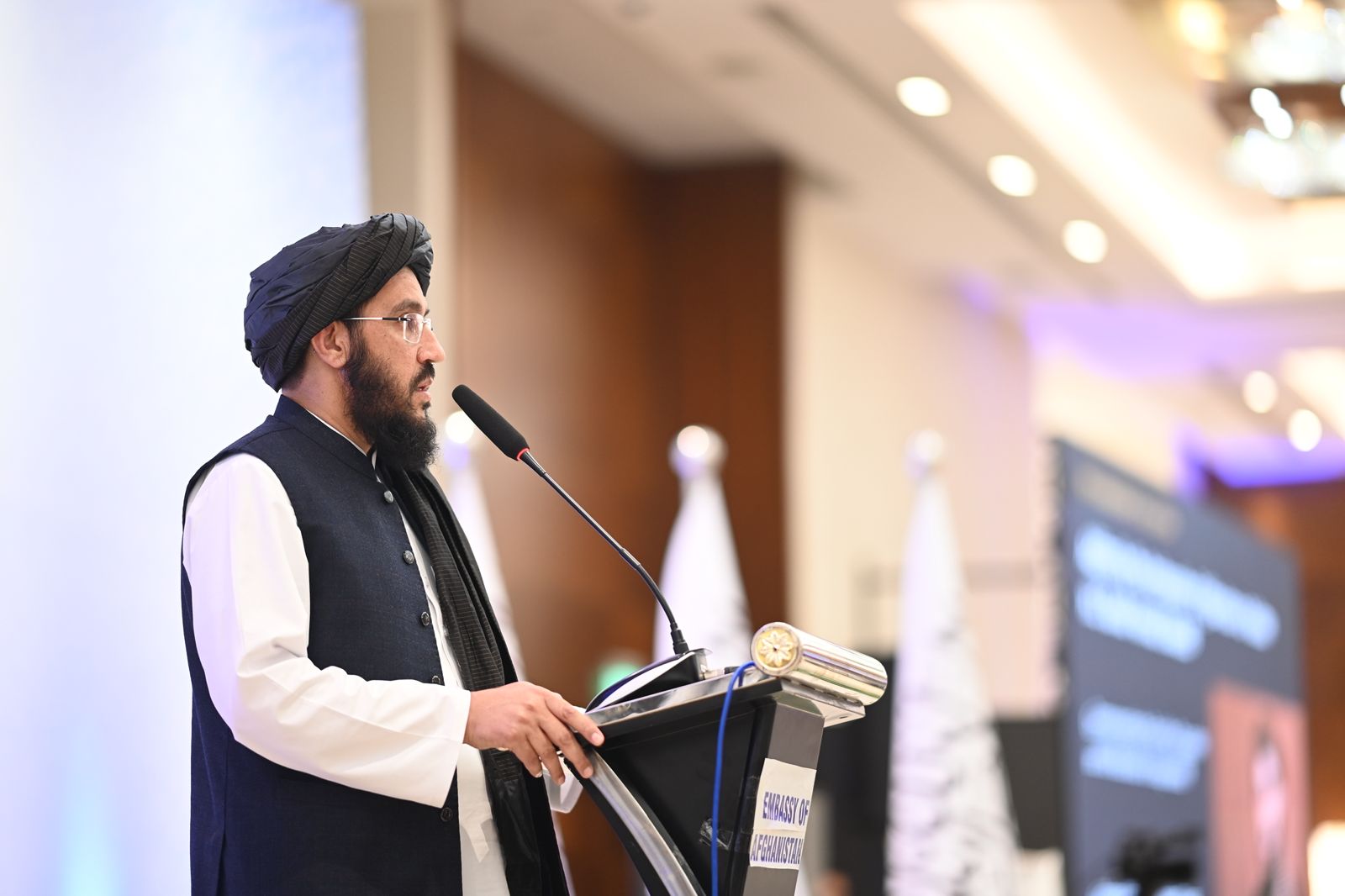
ISLAMABAD, The Embassy of Afghanistan in Islamabad hosted a ceremony to commemorate the fifth anniversary of what the Islamic Emirate of Afghanistan describes as the end of the occupation and the restoration of Afghanistan’s independence.
Afghanistan Ambassador Sardar Ahmed Shakeeb addressed the gathering, while Jamiat Ulema-e-Islam (JUI-F) chief Maulana Fazlur Rehman also participated and delivered a speech, emphasizing the historical, religious, cultural and geographical ties between Pakistan and Afghanistan and calling for dialogue, mutual understanding, cooperation and stronger relations between the two neighboring countries.
Afghan Ambassador Sardar Ahmed Shakeeb’s Address
Welcoming the distinguished guests, Afghanistan Ambassador Sardar Ahmed Shakeeb said it was his great pleasure to welcome everyone to the gathering marking the fifth anniversary of the end of the occupation of Afghanistan and what the Islamic Emirate considers the restoration of the country’s independence.
On behalf of the Government and people of Afghanistan and the Embassy of Afghanistan in Pakistan, he thanked all participants for accepting the invitation and honoring the important national occasion with their presence.
Sardar Ahmed Shakeeb said that five years ago, on August 15, the Afghan people had opened a new chapter in their contemporary history.
After more than four decades of war, foreign intervention and immense suffering, he said, Afghanistan had once again taken into its own hands the authority to determine its future.
He said the occasion was not merely the anniversary of a political transformation but also marked the beginning of a new chapter for Afghanistan.
According to the Afghan ambassador, Afghanistan had left behind the chapter of war and embarked on a new path under unified leadership and within an Islamic system, with a focus on implementing Islamic Sharia, strengthening independent decision-making, consolidating lasting stability, pursuing reconstruction and economic growth, and expanding relations with the international community on the basis of mutual respect.
He said the new chapter and strengthened peace in Afghanistan were not only in the interest of the Afghan people but also served the shared interests and needs of the region and the wider world.
A peaceful and stable Afghanistan, he said, could create significant opportunities for regional connectivity, economic cooperation and collective security and could play a constructive role in strengthening peace and prosperity across the region.
Afghanistan as a Bridge Between Central and South Asia
Sardar Ahmed Shakeeb said the region was among the most promising parts of the world in terms of its potential for economic growth, connectivity and cooperation.
He said that if the shared geographical advantages of the region were managed wisely, Afghanistan could play its historic role as a natural bridge between Central and South Asia.
Such a role, he said, could open new opportunities for trade, transit, investment and energy cooperation.
“We firmly believe that the stability of Afghanistan is inseparable from the stability of the region, and the prosperity of the region is closely linked to the prosperity of Afghanistan,” he said.
Pakistan Holds a Key Position in Afghan Foreign Policy
The Afghan ambassador said Afghanistan’s neighbors held the first and most important place in the country’s foreign-policy vision.
He said geography had made Afghanistan and its neighbors connected, while shared history, common faith and culture, centuries-old trade relations and family and social ties connecting millions of people had created bonds that could not easily be separated.
“These deep ties call for mutual respect, shared interests, and a shared commitment to our common future,” he said.
Sardar Ahmed Shakeeb said Afghanistan did not view its neighbors merely as countries of the region, but considered them natural partners in shared future prosperity.
He specifically emphasized Afghanistan’s desire to establish relations with Pakistan based on mutual respect, equality of sovereignty, non-interference in each other’s internal affairs and the pursuit of shared interests.
Call for Dialogue Instead of Pressure
Sardar Ahmed Shakeeb said an atmosphere of trust could not be created through pressure or force.
“It can only be built through understanding, sustained dialogue, and sincere cooperation,” he said.
He said these principles were consistent with the guidance of Islamic Sharia, the directives of the Amir-ul-Momineen, accepted principles of international relations and the enduring values of good-neighborly relations.
The Afghan ambassador acknowledged that occasional differences between neighboring countries were natural but stressed that disagreements should not become a reason for greater distance.
“During times of disagreement, the path of dialogue, mutual respect, and political wisdom should be pursued,” he said.
He added that every challenge, when addressed with sincerity and goodwill, could become an opportunity to build trust and expand cooperation.
Afghanistan’s Security Position
Sardar Ahmed Shakeeb said lasting and sustainable security could only be achieved through mutual trust, sincere cooperation, practical coordination and respect for each other’s legitimate concerns.
“The stronger the trust between us, the stronger the foundations of peace, stability, and prosperity throughout our region will become,” he said.
He stated that Afghanistan did not pursue a policy of confrontation and would not allow its territory to be used against the security and stability of any other country.
At the same time, he expressed hope and confidence that Afghanistan’s legitimate security concerns would be understood and respected and that no country would allow its territory to be used against Afghanistan.
He said Afghanistan remained ready to further strengthen practical and constructive cooperation with its neighbors on the basis of these principles.
Afghanistan to Become a Bridge for Regional Cooperation
The Afghan ambassador said Afghanistan’s vision was clear: the country should not be a field for geopolitical competition but should serve as a bridge for regional connectivity, trade, transit, dialogue and cooperation.
He said Afghanistan’s geographical position could provide a foundation for stronger economic and regional links between Central and South Asia.
Concluding his address, Sardar Ahmed Shakeeb expressed heartfelt gratitude to all participants, saying their presence reflected respect, friendship and mutual goodwill.
He prayed that Almighty Allah would guide Afghanistan, the region and the entire world toward success, peace, stability and prosperity.
Maulana Fazlur Rehman Endorses Afghan Ambassador’s Message
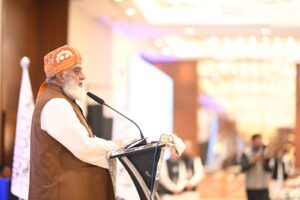
JUI-F chief Maulana Fazlur Rehman, addressing the ceremony, warmly greeted Afghanistan Ambassador Sardar Ahmed Shakeeb and all other participants.
He said he fully endorsed the Afghan ambassador’s sincere expression of the desire for better relations between Afghanistan, Pakistan, neighboring countries and the wider region.
Maulana Fazlur Rehman said that, on his own behalf and on behalf of Pakistan and the people of Pakistan, he wanted to reciprocate Afghanistan’s goodwill with even greater goodwill.
“Our historical, religious and cultural ties demand that we determine our future as two strong and peaceful neighboring countries and seek stable foundations for a new future,” he said.
“I am confident that Pakistan will be a support for Afghanistan and Afghanistan will be a support for Pakistan.”
Iqbal’s Vision of Afghanistan
Referring to Allama Muhammad Iqbal’s description of Afghanistan’s geographical importance, Maulana Fazlur Rehman recited:
«“Asia is a single body of water and clay,
The Afghan nation is its heart.
From its opening comes Asia’s opening,
From its disorder comes Asia’s disorder.”»
He said that after the establishment of Pakistan, Pakistan had also acquired major geographical importance as a bridge.
“Whether it is the Middle East, Central Asia, East Asia or South Asia, Pakistan and Afghanistan can today jointly play the role of a geographical bridge that brings the West and East closer,” he said.
He stressed that both the Islamic Emirate of Afghanistan and the Islamic Republic of Pakistan must recognize the region’s geographical importance and understand its significance in determining a common future.
“I believe this could be a guiding step for the entire Muslim world, capable of bringing the whole Islamic world together around a common unity,” he said.
Call for an Islamic Bloc
Maulana Fazlur Rehman said Muslims had always been considered one Ummah and that he had consistently supported the establishment of an Islamic bloc.
He said if Pakistan, Saudi Arabia, Türkiye and Iran made progress in this direction, other parts of the Islamic world could eventually join and become partners in the process.
He said the present circumstances demanded that Muslim countries reduce and ultimately end their dependence on global powers, consolidate their collective strength and rely on their own capabilities.
He called for Muslim countries to turn toward Allah and work toward becoming one united Ummah.
Pakistan-Afghanistan Differences Should Be Resolved Through Dialogue
Maulana Fazlur Rehman said the gathering had brought together many important people from Pakistan and that he wanted to convey a message to Afghanistan’s brothers on behalf of Pakistan, the Pakistani people and the Muslims of the country.
He expressed hope that Allah would grant everyone the ability to implement this vision and remove all obstacles standing in its way.
He said the difficulties between Pakistan and Afghanistan could be resolved through dialogue, mutual understanding and communication.
“In my view, there is no disagreement over removing these difficulties. There is a desire on both sides to resolve these issues so that we can present ourselves before the world not merely as neighboring countries, but as neighboring and brotherly Islamic countries, standing together as one,” he said.
He emphasized that both sides should demonstrate their shared desire to remove existing obstacles and improve bilateral relations.
“May Allah grant us the ability to do so,” he said.
‘We Desire Pakistan and Afghanistan to Become One’
Maulana Fazlur Rehman thanked the organizers for giving him an opportunity to speak, saying he had not known beforehand that he would be asked to address the gathering.
He said he had simply expressed what Allah had placed in his heart on the occasion.
“I believe Allah is witness to the fact that we desire Pakistan and Afghanistan to become one, and God willing, we will determine our future by becoming one,” he said.
He concluded his remarks with the words:
“And our final prayer is that all praise belongs to Allah, Lord of the worlds.”
The speeches by Afghanistan Ambassador Sardar Ahmed Shakeeb and Maulana Fazlur Rehman underscored a shared emphasis on dialogue, mutual respect, regional connectivity, economic cooperation and stronger relations between Pakistan and Afghanistan, while highlighting their historic, religious, cultural and geographical ties.
