

By Qamar Bashir
Press Secretary to the President (Rtd)
Former Press Minister, Embassy of Pakistan to France
Former Press Attaché to Malaysia
Former MD, SRBC
For decades, Pakistan has aspired to transform itself into the principal gateway connecting South Asia with Central Asia, the Middle East, China, and Europe.
Geography has blessed Pakistan with an enviable location, yet political instability, inadequate infrastructure, and regional conflicts have prevented it from realizing its full strategic potential.
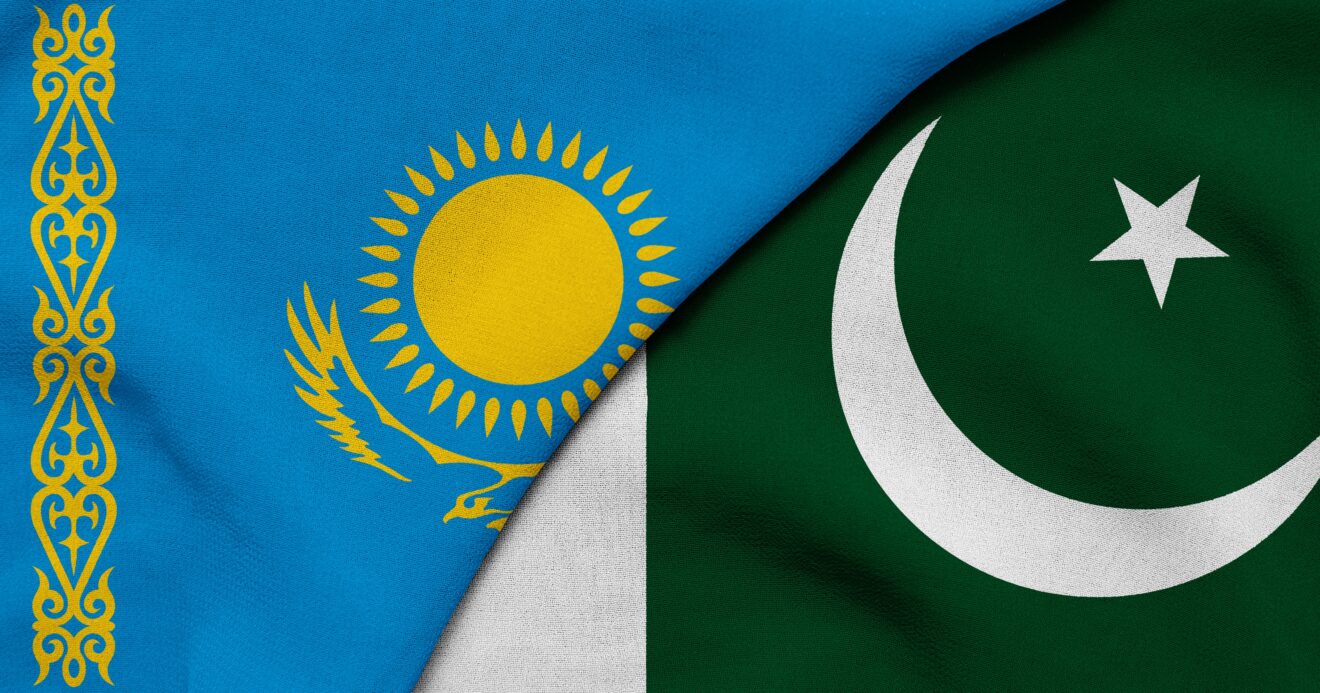
Today, however, the rapidly evolving geopolitical landscape of Eurasia presents a historic opportunity. Among the five Central Asian republics—Kazakhstan, Uzbekistan, Turkmenistan, Kyrgyzstan, and Tajikistan—Kazakhstan unquestionably emerges as Pakistan’s strongest strategic, economic, and geopolitical partner.
Kazakhstan is the largest country in Central Asia and contributes nearly half of the region’s economic output. It possesses enormous reserves of oil, natural gas, uranium, rare earth minerals, copper, zinc, and wheat, while maintaining one of the most stable investment climates in the former Soviet space. Pakistan, on the other hand, offers a population exceeding 250 million, an expanding industrial base, internationally competitive textile and pharmaceutical industries, sophisticated surgical instrument manufacturing, information technology expertise, and, most importantly, access to the Arabian Sea through Karachi, Port Qasim, and Gwadar.
These complementary strengths create a partnership based not on competition but on mutual advantage.
Kazakhstan’s greatest strategic challenge is that it is the world’s largest landlocked country. Its exports must travel thousands of kilometers through Russia, China, or across the Caspian Sea before reaching international markets. Pakistan offers an alternative southern corridor that could substantially reduce transport costs and provide Kazakhstan with direct maritime access to the Middle East, Africa, and South Asia. For Pakistan, this would mean becoming the preferred logistics and transit hub for Central Asia—a vision that successive governments have pursued under the “Connect Central Asia” policy.
The economic potential of this partnership extends far beyond present bilateral trade. Although current trade remains relatively modest, it represents only a tiny fraction of what both economies can achieve.
Based on existing sectoral strengths, announced infrastructure initiatives, and regional trade opportunities, the Pakistan-Kazakhstan partnership could reasonably generate US$35–60 billion in cumulative direct and indirect economic activity over the next decade if major connectivity projects are successfully implemented.
The estimated sector-wise potential is as follows:
Energy cooperation (oil, gas, uranium, electricity): US$8–10 billion
Transit trade, ports, logistics, railways and warehousing: US$7–9 billion
Infrastructure development and industrial zones: US$6–8 billion
Mining, minerals and metallurgy: US$4–6 billion
Agriculture, wheat, livestock and food processing: US$3–4 billion
Textiles, pharmaceuticals, surgical instruments and manufacturing: US$2–3 billion
Information Technology, digital services and fintech: US$1.5–2.5 billion
Tourism, aviation, education and cultural exchanges: US$1–2 billion
Banking, insurance and financial services: US$1–2 billion
Defence cooperation, aerospace technologies and strategic industries: US$2–4 billion
These figures are analytical estimates, not official government forecasts, but they demonstrate the enormous untapped potential of a comprehensive economic partnership.
Perhaps the most immediate opportunity lies in connectivity. If road and railway corridors through Afghanistan become fully operational, Kazakhstan could utilize Karachi, Port Qasim, and Gwadar as its principal southern gateways. This would not only reduce transportation costs for Kazakhstan but also generate substantial revenue for Pakistan through port handling, customs duties, shipping services, banking, insurance, warehousing, freight forwarding, and industrial activity surrounding these logistics corridors.
Energy cooperation deserves equal attention. Kazakhstan ranks among the world’s leading producers of uranium and possesses substantial oil and natural gas reserves. Pakistan’s growing economy requires diversified and reliable energy supplies. Long-term agreements covering crude oil, refined petroleum products, uranium for peaceful nuclear energy, renewable technologies, and electricity cooperation could significantly strengthen Pakistan’s energy security while providing Kazakhstan with a dependable South Asian market.
Agriculture offers another promising frontier. Kazakhstan is one of the world’s largest wheat exporters, while Pakistan possesses advanced irrigation systems, food processing expertise, seed technology, and a thriving halal food industry. Joint ventures in agricultural research, livestock development, dairy production, edible oils, and food exports could substantially strengthen food security for both nations.
Industrial cooperation presents equally attractive opportunities. Pakistan’s internationally recognized textile sector, pharmaceutical manufacturers, surgical instruments industry, sports goods exports, and emerging IT companies can access Kazakhstan’s expanding consumer market. In return, Kazakh investors can benefit from Pakistan’s Special Economic Zones, manufacturing base, logistics infrastructure, and competitive labor costs.
The strategic importance of Kazakhstan extends beyond economics. Both countries enjoy cordial political relations and cooperate actively through the Shanghai Cooperation Organisation (SCO), the Organization of Islamic Cooperation (OIC), and the Economic Cooperation Organization (ECO). They share common interests in regional stability, counterterrorism, economic integration, and enhanced Eurasian connectivity.
Challenges certainly remain. The absence of direct land connectivity, banking limitations, visa restrictions, inadequate transportation infrastructure, and geopolitical uncertainties surrounding Afghanistan continue to constrain bilateral commerce. Alternative routes through Russia, China, Iran, and the Caspian Sea also compete for regional trade flows.
However, these challenges are not insurmountable. Strategic investments in infrastructure, harmonized customs procedures, expanded air links, stronger banking cooperation, and greater private-sector engagement can gradually unlock the partnership’s enormous potential.
Pakistan’s ambition of becoming the economic bridge between South Asia and Central Asia cannot be realized without a strong anchor partner. Kazakhstan possesses the economic strength, political stability, financial resources, and regional influence necessary to play that role.
History often rewards nations that recognize strategic opportunities before others do. Today, Pakistan and Kazakhstan stand at precisely such a crossroads. By transforming diplomatic goodwill into comprehensive economic cooperation, both countries can build one of Eurasia’s most significant bilateral partnerships.
For Pakistan, Kazakhstan is far more than another Central Asian friend. It is the region’s largest economy, a dependable energy partner, a gateway to wider Eurasian markets, and a country whose prosperity is closely aligned with Pakistan’s own strategic aspirations. If both governments pursue this relationship with vision, determination, and sustained investment, the Pakistan-Kazakhstan partnership could become one of the defining economic success stories of the next decade—creating an estimated US$35–60 billion in shared economic value while reshaping the geopolitical and commercial landscape of Central and South Asia.