
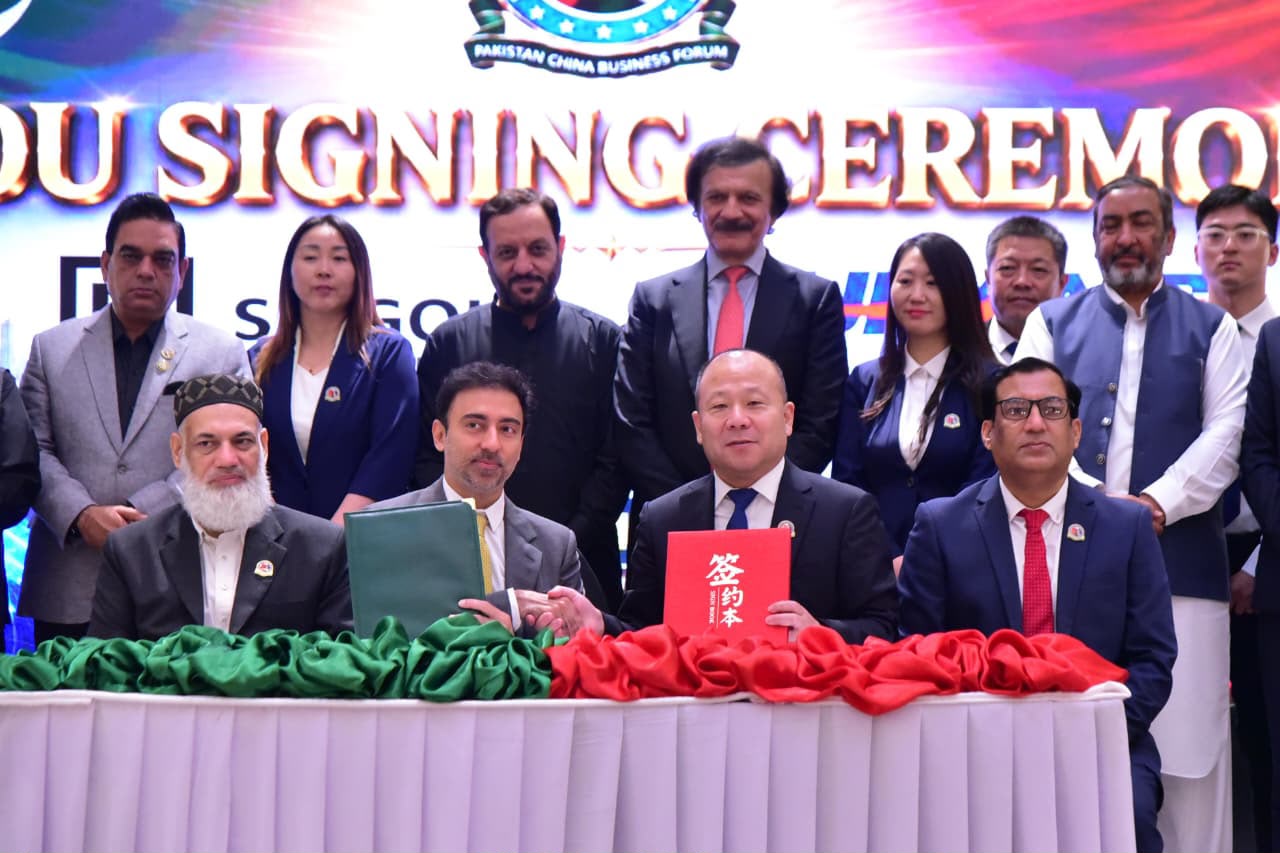
Islamabad, A landmark Memorandum of Understanding (MoU) was celebrated at the Mövenpick Hotel, Centaurus Islamabad, marking a major milestone in Pakistan-China industrial cooperation. The agreement between Saigols Group (Pakistan) and Hebei Juhang Energy Technology Group (China) aims to establish collaboration in advanced lithium-ion batteries, energy storage systems, electric vehicle charging infrastructure and other clean energy technologies.
Addressing the ceremony, Special Assistant to the Prime Minister on Industries and Production, Mr. Haroon Akhtar Khan, described the partnership as far more than a commercial agreement, calling it “a declaration of confidence in Pakistan’s industrial future and in the enduring strength of Pakistan-China cooperation.”
He congratulated both Saigols Group and Hebei Juhang Energy Technology Group on forging a partnership that would contribute significantly to Pakistan’s industrial transformation and technological advancement.
Haroon Akhtar Khan stated that the Pakistan-China relationship has continuously evolved with changing global realities and new economic opportunities. What began as a partnership built on trust has now emerged as one of the world’s most successful models of strategic cooperation, entering a new era driven by innovation, advanced manufacturing, clean energy, technology transfer and industrial collaboration.
He noted that China’s remarkable transformation into a global leader in innovation, electric vehicles, battery technologies, renewable energy, artificial intelligence and advanced manufacturing provides valuable lessons for developing economies. Pakistan, he said, is proud to strengthen its partnership with China as both countries work together to shape the industries of the future.
The Special Assistant emphasized that the global economy is undergoing profound transformation, with technological innovation, intelligent manufacturing and green industries becoming the defining drivers of economic competitiveness.
He said that under the visionary leadership of Prime Minister Muhammad Shehbaz Sharif, Pakistan is implementing one of the most ambitious programmes of industrial and economic transformation in its history. Guided by a strategy centred on production, exports, innovation and private enterprise, the Government is laying the foundations of a globally competitive, technologically advanced and investment-friendly economy capable of creating quality employment, expanding exports and attracting international investment.
Haroon Akhtar Khan highlighted that the Government’s reform agenda includes the National Industrial Policy, the National Tariff Policy and a comprehensive Regulatory Reform Programme aimed at reducing the cost of doing business, simplifying regulatory procedures and creating a transparent, predictable and investor-friendly business environment.
“As I have often said, we are replacing red tape with red carpets for investors,” he remarked.
He observed that the proposed establishment of a lithium-ion battery assembly and manufacturing facility in Pakistan represents not merely a single investment but the beginning of an entirely new industrial ecosystem combining Chinese technological expertise with Pakistan’s entrepreneurial capabilities and strategic geographic location.
The Special Assistant further noted that Pakistan is witnessing one of the fastest expansions of solar energy adoption in the region, making reliable energy storage systems increasingly important. Local manufacturing of advanced lithium-ion batteries, he said, will reduce dependence on imports, strengthen Pakistan’s clean energy supply chain, create high-value employment, develop indigenous engineering capabilities and stimulate supporting industries across the manufacturing sector.
Calling battery manufacturing one of the most strategic industries of the twenty-first century, Haroon Akhtar Khan said that industrialization must be driven by innovation, technology and sustainability to ensure long-term national prosperity.
He reaffirmed the Government of Pakistan’s commitment to facilitating strategic investments and ensuring that Pakistan remains a reliable, competitive and rewarding destination for international investors.
“Today’s ceremony demonstrates what becomes possible when sound public policy and private enterprise move together with a shared purpose,” he said.
The Special Assistant concluded by stating that Pakistan and China are united by a shared vision of innovation, industrial excellence, sustainable energy and common prosperity. He expressed confidence that the Memorandum of Understanding would mark the beginning of a new chapter in Pakistan’s industrial transformation, inspiring further investment, technology transfer and long-term economic cooperation.
The agreement represents a significant step towards promoting local manufacturing, clean energy technologies, import substitution, export-oriented industrialization and sustainable economic growth in Pakistan.
Pakistan Zindabad. Pakistan-China Friendship Zindabad.
