



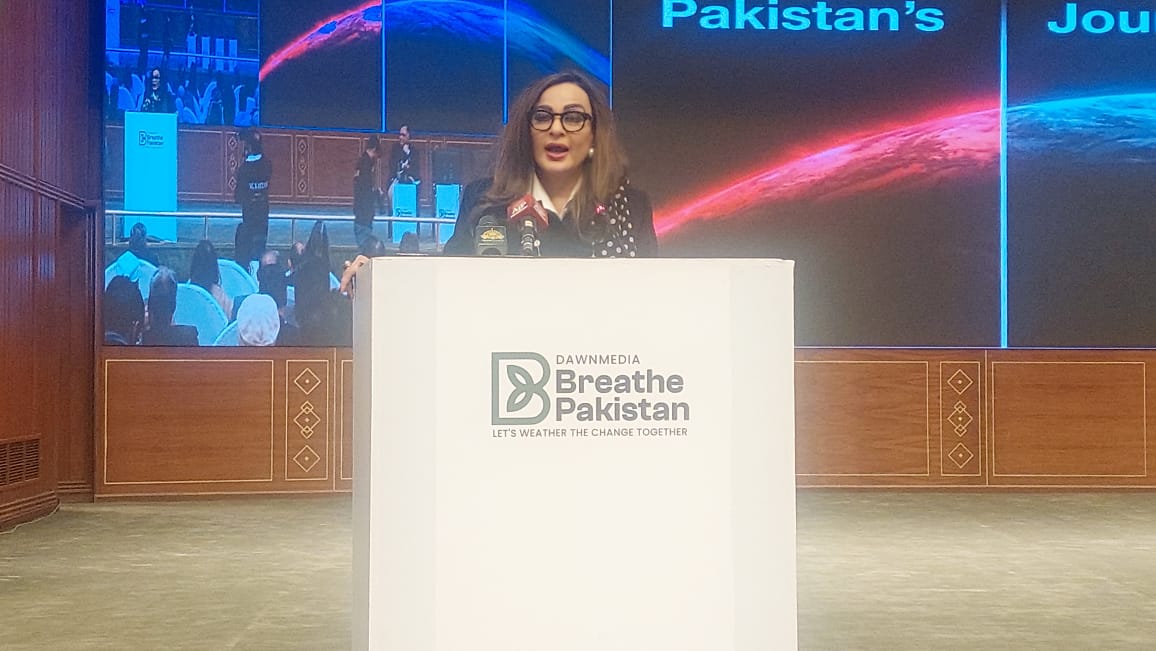
Islamabad: Chair of the Senate Standing Committee on Climate Change, Senator Sherry Rehman, delivered a compelling keynote address at the Dawn Breathe Climate Conference today. She emphasized the urgent need for a national reckoning on climate action, stressing that Pakistan can no longer afford to treat climate change as an external crisis. She lauded Dawn Media for this important initiative in fostering public dialogue on the existential threat of climate change.
Senator Rehman underscored that while Pakistan’s energy mix now comprises 55% renewables, critical policy issues such as the National Clean Air Policy must be at the forefront of national discourse. “Air pollution is a serial killer,” she stated, citing that 128,000 deaths annually in Pakistan are attributed to air pollution, reducing life expectancy by an average of 3.9 years. Smog alone affects 11 million children, while air pollution costs Pakistan $47 billion annually, nearly 5.88% of its GDP.
Highlighting that climate change does not respect borders, Senator Rehman drew attention to recent wildfires in Los Angeles, likening them to the devastating 2022 Balochistan fire that burned over 26,000 acres of ancient chilgoza pine forests, causing losses of $20 million to local communities. These forests contribute $30-40 million annually to Pakistan’s economy, yet climate-induced disasters continue to wipe out natural capital. “This is a quantum shift,” she warned. “The climate clock is ticking, and inaction will bring devastation to our doorstep.”
She stressed that climate change is no longer a future threat but a structural issue defining global and national choices. “What happened in Pakistan will not stay in Pakistan,” she said. “The world saw what unfolded during the 2022 floods, which submerged one-third of the country. Many other nations are now experiencing similar climate catastrophes.”
Speaking about international climate negotiations, Senator Rehman remarked that despite 29 global climate conferences, climate financing remains a bottleneck for developing nations. “At COP27, Pakistan secured a Loss and Damage Fund, but even if that fund gets completely capitalized, we won’t be able to extract those funds easily,” she said. Citing World Bank estimates, she stated that Pakistan requires $348 billion by 2030 to address climate change challenges, yet the financial architecture remains heavily skewed against vulnerable nations.
“The biggest issue is that Pakistan continues to look at climate as an external problem,” she said. “We go to multilateral tables seeking climate finance, but this is not just about money. It is about rejecting business-as-usual (BAU) approaches and treating climate as the core development lens for all national policies.”
She warned against the growing retreat of multilateralism, noting that the rules-based order of the post-World War II era is in ICU. “Developing countries need $1.3 trillion annually for climate finance, but every time we ask where this money will come from, we are met with silence. Meanwhile, in 2022 alone, fossil fuel subsidies amounted to a staggering $7 trillion globally. The irony is stark, the money exists within the global financial system, but it is being funneled elsewhere—propping up industries that drive the crisis rather than supporting those on the frontlines of its impact.”
Senator Rehman underscored Pakistan’s water crisis, calling for an urgent shift in the country’s relationship with water. “Pakistan is the fourth largest per capita user of water globally and has already entered water scarcity in 2025,” she noted. “Only 1% of wastewater is treated, while 9 million gallons of sewage are dumped into Rawal Dam. The Indus River, Pakistan’s lifeline, is now the second most polluted river in the world due to industrial waste and plastic pollution.”
She pointed out the alarming scale of solid waste and plastic pollution “Pakistan generates 49.6 million tons of solid waste annually, increasing by 2.4% per year. Around 65% of waste on Pakistan’s beaches consists of plastic bottles, bags, and packaging. 55 billion plastic bags are used annually, with a 15% yearly increase. By 2050, there could be more plastic than fish in the oceans if this trajectory continues. Plastics contain ‘forever chemicals’ that pose long-term health risks.”
Senator Rehman commended Pakistan’s National Adaptation Policy and provincial climate policies, but stressed the need for coordinated implementation. “Pakistan’s climate response cannot be fragmented. Action must be taken at both the provincial and national levels.”
She emphasized that Pakistan is undergoing a rooftop solar revolution, having imported one-third of its installed capacity. “But this is just the beginning,” she stated. “Pakistan must integrate climate resilience into all development sectors, from energy to urban planning.”
Senator Rehman warned of the return of climate denialism, noting that the strategic drift in policy is leading to biodiversity loss, water insecurity, and extreme pollution. “Pakistan has one of the highest deforestation rates in Asia. We lose 27,000 acres of forest cover annually, shrinking our forest cover to just 4.8%. This leads to extreme flooding and ecosystem collapse, costing the economy PKR 2.3 billion per year.”
Senator Rehman called for climate action to be mainstreamed in Pakistan’s economic strategy. “The most important bumper sticker for Pakistan should be: ‘No one is coming for you.’ If your house is on fire, you must save yourself. No one is bringing trillions of dollars to your doorstep. Climate finance is a right, but we must also act at home.”
As global emissions continue to rise, Senator Rehman noted that 1.5°C is no longer alive. “For the past three years, Pakistan has recorded some of the hottest cities in the world crossing 50°C. In the UK, when temperatures reach 40°C, it is declared a climate emergency. We need to do the same.”
Senator Rehman concluded with a call to action, urging Pakistan’s media, policymakers, and citizens to amplify climate issues before they are eclipsed by other crises. “The cost of inaction is clear. The climate clock is ticking. What we do today will define our future. The choice is ours.”
